

- Product name
- Green Terramesh®
- Soil reinforcement
- Steel grid / geotextile
- Facing material
- Welded mesh
- Facing finishes
- Vegetated
- Maximum slope angle (deg.)
- 70
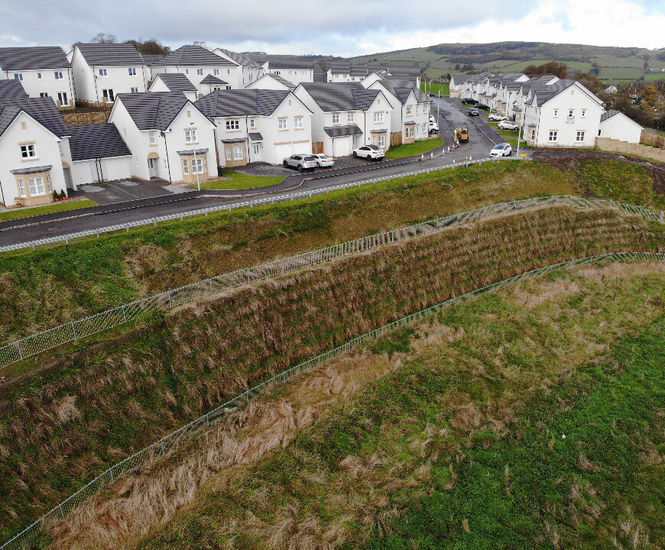
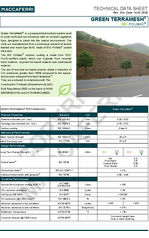
Green Terramesh® is an environmentally-friendly, modular system used to form vegetated (green) faced soil-reinforced slopes (RSS) and embankments. It consists of pre-fabricated units of double-twisted wire mesh lined with an erosion control blanket and stiffened with a welded mesh panel. Pre-formed steel braces are supplied to be connected at the job site to maintain the unit to the required slope angle during backfilling operations, removing the need for any external formwork or shuttering.
The angled front face and erosion control blanket are designed to facilitate the establishment of natural vegetation of the units; an important requirement of Green Terramesh®. As all components are factory-fitted, Green Terramesh® is more rapid to install than competitors' reinforced soil systems. A structural backfill is placed upon the soil reinforcement geogrids and a suitable fill is placed immediately behind the front face. Green Terramesh®, includes good quality topsoil being placed immediately behind the front face to promote the rapid vegetation of the slope.
System components
The system consists of pre-fabricated units of double-twisted wire mesh (8×10 type) lined with an erosion control blanket and stiffened with a welded mesh panel. Two pre-formed steel braces are supplied to be connected at the job site to maintain the unit to the required slope angle.
The angled front face and the erosion control blanket are designed to facilitate the establishment of natural vegetation of the units; an important requirement of Green Terramesh®.
The characteristics of an erosion control blanket vary depending on the conditions of where the system is to be used; “Water Type” or “Earth Type”.
Reusing site-won fills requires the use of Maccaferri's ParaGrid® geogrids due to their excellent interaction coefficients with site-won fills. These are simply sandwiched between the layers of Terramesh® units. No connections, bodkins or jointing is required, speeding up installation time and limiting potential installation errors on site.
Installation
As all components are factory-fitted, Green Terramesh® is very quick to install. The unit is simply erected on site, the bracing angles support the face at the designated angle without the need for any external formwork or shuttering.
A structural backfill is placed upon the soil reinforcement geogrids, and a suitable fill is placed immediately behind the front face. For example, on a revegetating ‘Earth Type’ unit, good quality topsoil would be placed immediately behind the front face to promote the rapid vegetation of the slope.
Manufacture
All Terramesh® units are fabricated from high-quality Class A heavily galvanised steel wire with an additional polymeric coating, PoliMac®. PoliMac® is a revolutionary coating exclusive to Maccaferri that can withstand the increasingly aggressive environmental conditions brought on by global climate changes and offers significant advantages over traditional PVC-coated wires; 10x resistance to abrasion, 2x resistance to chemical aggression, 4x performance in cold weather, and 4x resistance to UV rays.
Units are produced in Maccaferri's factories around the world, in many of which the management and production system is certified in compliance with ISO 9001.
Accreditation
In selected factories, the Green Terramesh® units are produced in compliance with CPR – Construction Product Regulation 305/2011, having EC marking in compliance with ETA-13/0295.
The management and production system is certified in compliance with ISO 9001 and ISO 14001 (related to the environmental management system).
Part 1 – Product
1.1 Description
Double twisted steel wire mesh soil reinforcement units with inclined vegetative facing (Green Terramesh Light) shall be manufactured in compliance with BS EN 10223-3, with Zn-Al alloy and a High Abrasion Resistant (Polimac® or equivalent) polymer coated steel wire. Units are manufactured in compliance with The Construction Products (Amendment etc.)(EU Exit) Regulations 2020 on the basis of UKAD 200026-00-0102 “Steel mesh systems for reinforced fill” and UKTA-0836-22/0022.
[For Republic of Ireland: The units are manufactured in accordance with Construction Product Regulation CPR 305/2011, and have a CE marking in compliance with EAD 200026-00-0102.]
The management and production system of the supplier shall be certified in compliance with ISO 9001.
All listed performances must be verifiable on laboratory test reports conducted by independent research institutes, the relevant documentation shall be submitted to the supervisor for the acceptance of the material.
1.2 Functional characteristics
The tensile strength of the steel wire mesh shall be 40 ± 5 kN/m, in accordance with BS EN 10223-3.
The punch resistance of the steel wire mesh shall be 41 ± 5 kN; tests on a 3x3m sample laterally constrained following the UKAD 200026-00-0102 and ISO 17746 test methodology.
The 120 years long-term tensile strength (LTDS) for soil pH levels in the range of 3-13 will be different depending on the fill material used as reported in the table below:
Fill material |
Maximum particle size (mm) |
LTDS [kNm-1] |
Silt and Clay |
<0,06 |
32,1 |
Sands |
<2 |
32,1 |
Sandy gravels |
<9,5 |
30,5 |
Coarse gravels |
<38 |
27,9 |
Crushed stones |
<200 |
26,3 |
The values of the reduction coefficients will be provided by the manufacturer but will have to be validated by a third-party accredited certification institution (e.g. BBA, British Board of Agreement or NTPEP): the relevant accreditation shall be submitted to the supervisor for the acceptance of the material.
Minimum requirements of Stiffness EA and Strain e at yielding at specific soil confinement pressures:
Embedded mesh tensile test (BS EN 13738 or ASTM D6706) at soil confinement pressures of: |
Stiffness EA at characteristic yielding not smaller than (=): |
Strain e at characteristic yielding not bigger than (=): |
|
35 kPa |
500 kN/m |
6.2% |
|
75 kPa |
750 kN/m |
4.3% |
|
150 kPa |
1100 kN/m |
3.1% |
1.3 Materials
The double twisted steel wire mesh shall be manufactured with hexagonal 8x10 mesh type (BS EN 10223-3, Table 2), woven with a drawn steel wire core of 2.20 mm in diameter, with a minimum quantity of 230 g/m2 of Zn-Al metallic coated alloy, in accordance with ISO 7989-2 and BS EN 10244-2, Table 2, Class A.
The double twisted steel wire mesh shall be resistant to outwearing accelerated ageing when subject to test in a Sulphur dioxide environment (ISO 22479): after 28 cycles of discontinuous test, the mesh shall not show more than 5% of DBR (Dark Brown Rust).
The metallic coated wire core shall be protected with a high abrasion-resistant polymer coating (Polimac® or equivalent), grey in colour, with a nominal thickness of 0.5 mm, resulting in a nominal overall diameter of 3.20 mm.
1.4 Polymer coating
The polymer coating shall not contain heavy metals and be resistant to:
Outwearing accelerated ageing in salt spray (ISO 9227): after 15,000 hours of exposure, the mesh shall not show more than 5% of DBR (Dark Brown Rust).
Abrasion test, in accordance with the procedure described in ASTM A975-23: after 300 cycles the polymer coating shall not expose the metal wire.
UV radiation, in accordance with ISO 4892-3, type 1A: after 2,500 hours of exposure to QUV-A the tensile strength and elongation at break of the base compound shall not change more than 25% from the initial test results. The polymer coating shall not release phthalates during the degradation process.
The brittleness temperature shall be lower than -35°, tested in accordance with ASTM D746.
Corrosion spread test, in accordance with the procedure described in ASTM A975-23: the maximum corrosion length measured shall be always less than a mesh repetition on wire samples immersed in an acid solution with an unprotected end for 2500 hours.
1.5 Lacing
Stainless steel rings shall be used for fastening operations and shall have the following characteristics:
Diameter: 3.00mm
Tensile strength > 1550 MPa
Pull-apart strength > 2.0 kN
1.6 Environmental and sustainability properties
1.6.1 Environmental Product Declaration
The soil reinforcement (Terramesh® Green Light) units shall have a Type III Environmental Product Declaration (EPD) registered and certified in accordance with ISO 14025 and BS EN 15804, to evaluate the environmental impact and give the possibility to calculate the Life Cycle Assessment (LCA) of the designed technical solution.
Such sustainability performances/requirements have to be reported in the Type III EPD certificate; certifications of non-authorised bodies or self-certificates issued by the manufacturer, are not allowed.
The value shall be declared, as per Table 1, in terms of Global Warming Potential (GWP 100 years) and expressed in kg CO2-Equiv./kg.
Table 1 – Environmental and sustainability properties |
|||
Global Warming Potential (GWP 100 years) |
ISO 14025 BS EN 15804 |
certified numeric value |
[kg CO2-Equiv./kg] |
1.6.2 Environmental harmlessness
The polymer-coated steel wires shall be tested to ensure their Environmental Harmlessness according to the following procedures:
Synthetic Precipitation Leaching Procedure (SPLP) preparation as per EPA 1312 and Metals in Water by ICPMS (low level) as per EPA 6020B in which the presence or not of 31 different metals shall be analysed using atomic spectroscopy.
The results shall be in compliance with (a) Water Framework Directive 2000/60/EC; (b) CCME Water Quality Guidelines for the Protection of Aquatic Life, Freshwater; (c) U.S. EPA National Recommended Water Quality Criteria (Aquatic Life, Freshwater), 2006.
PFAS test in water by SPE/LCMS as per EPA 537.1 in which the presence or not of 28 different PFAS shall be analysed, showing that the polymer-coated steel wires are PFAS free. Resulting in a concentration lower than 2 ng/L of PFOS and PFOA and < 4 ng/L for other PFAS.
ELUATE Tests on environmental safeness, conducted as per M GEOK E:2016, shall ensure that the polymer coating is not critical for the environment.
Smoke toxicity tests conducted as per ISO 5659-2 and BS EN 17084 shall ensure a Gases Conventional Index of Toxicity after 8 minutes sampling CITG (8) < 0.10 and a HCl concentration < 36 ppm
Part 2 – Execution
The product’s conformity shall be certified by a third-party Notified Body, according to the The Construction Products (Amendment etc.)(EU Exit) Regulations 2020, which shall assess the quality control process at the supplier’s production facility.
[For Republic of Ireland: The product’s conformity shall be certified by a third-party notified Body, according to CPR 305/2011, which shall assess the quality control process at the supplier’s production facility. Prior to the installation, and on each consignment of gabion units to the job site, the contractor shall provide the Supervisory Body with the relevant documentation (Declaration of Performance, D.o.P.) in original form, where product and supplier names, quantities and destination are specified.]
Soil reinforcement units shall be opened, unfolded and pressed out to their original shape. Once units are assembled and the foundation is prepared, levelled and graded, the pre-assembled units shall be placed in position empty and fastened to adjacent units to form a continuously connected, monolithic structural unit and lifted to the required slope angle.
Triangular steel brackets shall be rotated and securely attached to the bottom of the main unit. All connections shall be in accordance with BS EN 10223-3.
The erosion control blanket of each unit shall overlap for 100 mm the adjacent unit sideways, to ensure that the vegetative soil behind will not be exposed. Care shall be taken when placing the soil to ensure that the polymer coating is not damaged. After a layer of soil has been placed, sufficient hand shovelling shall be performed to achieve a uniform top surface before the soil compaction is carried out. Vegetative soil is placed behind the facing for about 0.3m. Then the soil compaction within 1.0 m from the face shall be executed with a light compactor to prevent bulging.
The soil fill shall be placed in 300 mm lifts and compacted to the required level. The soil material shall be of good quality, free draining, granular or selected. The recommended soil gradation is between 0.02 and 6 mm. Then the compaction shall be performed to 95% of standard Proctor, by using conventional compaction equipment. Once soil layers after compaction have achieved the top of the unit, the top end is folded and securely stapled to the soil.
When a hydro-seeding treatment or planting is required, native species shall be used to increase the chance of vegetation establishment; irrigation may be necessary.