

- Product name
- CONCRETESoundBlok
- Suitability
- Industrial property
- Railways
- Residential property
- Roads
- Schools
- Transport network
- Finish material
- Concrete
- Steel
- Timber / wood
- Absorbent / reflective
- Sound absorbent
- Sound reflective
- Product accreditation
- BS EN 1793-1:2018
- BS EN 1794-2:2018
- Support services
- Design
- Installation
- Site survey
- Sound absorption (dB)
- A4
- Sound insulation (dB)
- B4
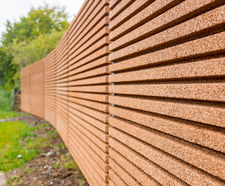
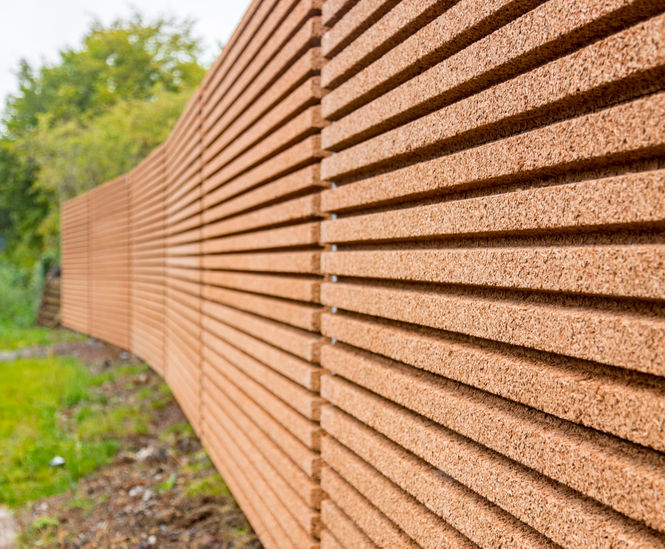
GRAMM CONCRETESoundBlok® noise barriers are made of a proprietary material consisting of organic softwood shavings processed to an acoustically engineered size and bonded together under pressure with Portland cement. GRAMM CONCRETESoundBlok® is highly sound absorptive, porous, rigid, non-combustible, thermally insulating and freeze-thaw resistant.
GRAMM CONCRETESoundBlok® noise barriers are panel and post systems. They are engineered in-house and specify the size for posts and the depth and diameter of footings. Standard steel posts or optional concrete posts can be accommodated.
Our standard systems are noise absorptive on both sides. They can also incorporate solid noise reflective or transparent elements, as well as integrated traffic barriers and retaining wall panels.
Each panel is made of high Strength concrete, with acoustical absorption. The size and pattern of the perforations are designed to protect and maintain the sound-absorptive capability of the acoustic fill inside the panels.
The reverse side of the panel facing away from the noise source, can be manufactured to offer a reflective or absorptive surface depending on the site requirements. The panels can be manufactured in a variety of architectural textures, patterns and colours. Due to the high density and strength of the CONCRETESoundBlok®, the system is well suited for areas where there are grade differences between the two sides of the barrier.
A unique design feature of the CONCRETESoundBlok® barrier construction is that individual panels can be removed and replaced. Panels are not bolted, welded, or otherwise permanently fastened to each other or to the support posts (Top security fixing added if required). Should replacement be called for as a result of structural damage, the panels can be changed in a safe and efficient way.