- Product name
- NATURALSoundBlok Absorptive
- Suitability
- Transport network
- Tunnels / subways
- Finish material
- Timber / wood
- Absorbent / reflective
- Sound absorbent
- Sound reflective
- Product accreditation
- BS EN 1793-1:2018
- BS EN 1794-2:2018
- Support services
- Design
- Dimensions (w x h)
- Width: 1-3m
- Height: 0.5-10m
- Sound absorption (dB)
- 35
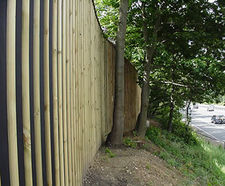
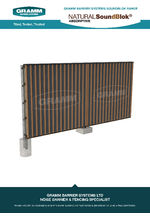
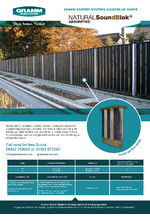
NATURALSoundBlok Absorptive timber noise barriers by Gramm Barrier Systems are made from pressure-treated, FSC-certified timber with a double acoustic board design for high sound reduction and a 30-year maintenance-free lifespan. Designed for rural settings, these barriers use mineral wool infill and are tailored to site requirements.
Timber acoustic barrier system for reducing noise in outdoor environments
Double acoustic board design maintains acoustic seal despite timber movement
30-year maintenance-free design life for both barrier and timber posts
High acoustic performance: DL? 32dB, Dla 12dB
Made from Tanalith E treated timber with mineral wool infill
Customisable heights from 0.5 to 10m and bay widths from 1 to 3m
All fixings are stainless steel for durability
Applications
Roadside noise reduction
Railway noise barriers
Rural and countryside developments
Residential boundary noise control
Commercial and industrial site perimeters
Dimensions
Height range 0.5–10m
Bay width range 1–3m
Weight 37.5kg/m²
Performance
Acoustic performance DL? 32dB, Dla 12dB
Design life 30 years (barrier and timber posts)
Design life 60+ years (steel posts)
Materials
Pressure-treated timber (Tanalith E)
Mineral wool infill (75mm thick, 100kg/m³ density)
Stainless steel fixings
Colours
Green or brown (Tanalith E treatment)
Finish
Tanalith E pressure-treated timber
Installation
Set into concrete foundations or bolted to concrete pads/strips
Galvanised steel or PPC posts with baseplates fixed using resin anchors or cast-in cradles
Steel posts can be set into augered or bucket dug concrete foundations
Accreditations
CE Marked for Highways England schemes (CPR 2013)
Compliant with Sector Scheme 2C for environmental barriers