

- Fill material
- Concrete
- Bag material
- Hessian
- Vegetable starch
- Application
- Canal banks
- Headwalls
- Retaining walls
- Revetments
- Riverbank reinforcement
- Shoreline protection
- Features
- Biodegrable
- Sitework
- Pre-filled
- Use
- Below water
- Reinforcement
- Rebar pins
- Steelwork
- Length (mm)
- 500
- Width (mm)
- 250
- Height (mm)
- 100
- Weight (kg)
- 20
SoluForm’s preformed concrete bagwork can be used below water. It has biodegradable potato starch liners that allow dry mix concrete to be placed below water in a clean and environmentally acceptable manner.
Prefilled bagwork needs water to hydrate the concrete. The bags are pierced with steel rebar pins to create a pathway for the surrounding water to enter and disperse around the concrete.
Tight packaging between the bags ensures there is no loss of cement fines from the bag when they are vertically pierced.
Hydration and hardening typically takes around 6-12 hours.
Steel rebar pins can also be used to tie blockwork to other structures, like abutments or retaining walls.
Applications
Structural underpinning of abutments and training walls subject to scour
Formation of scour protection within watercourses
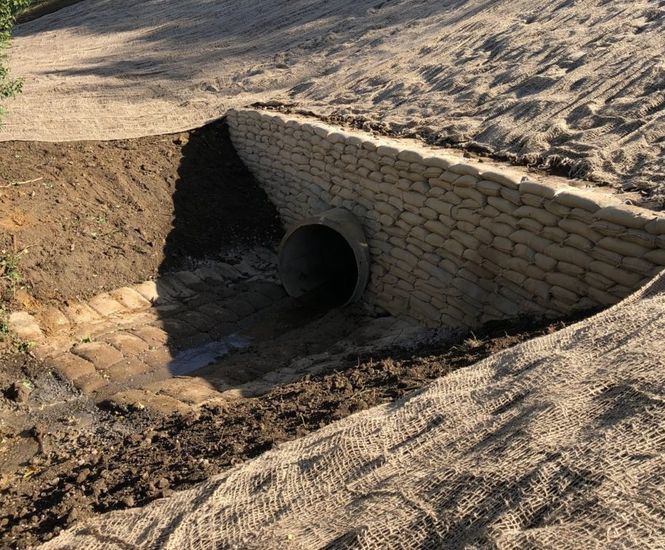
Creation of pipe, culvert or bridge headwalls and training walls
Formation of river walls, including repairs to existing walls
Creation of SUDS schemes, to create storage lagoons, etc
Earthwork retention
Embankment stabilisation works
Features and benefits
Simple to use - no specialist skills required
Cost-effective means of placing concrete underwater
Environmentally safe - no mixing or pumping of material within the river takes place, so placement is inherently safer for the watercourse
Liners biodegrade along with the hessian outer bags to leave the concrete block
Underwater liners and bags are manufactured from natural, renewable and sustainable resources
Biodegradable potato starch liner
Design mix options available
Highly adaptable system
Credentials
EPD (Environmental Product Declaration) certified by BRE
Carbon Offsetting
Installation procedure
Each bag placed flat and built up in rows, typically alternating or cross bonding to improve the strength of the finished blockwork.
After the second or third row of bags, steel rebar pins are used to provide a pathway for water to enter and hydrate the concrete, and to tie all the finished blockwork together.
Standard 300mm steelwork pins are inserted every two rows of bagwork, piercing 3 rows with a single 300mm pin.
Design Guidance
Soluform have a number of standard concrete bagwork wall designs for both in-water and non river applications. These are backed up with design calculations, risk assessments and design check statements and can be supplied upon request.