

- Sector
- Transport infrastructure
- Project type
- Refurbishment
- Services provided
- Product / system manufacture
- Product / system supply
- Year completed
- 2024
- Project location
- South West England
- Products used
- Platipus S6 anchors
- Geomat
Overview
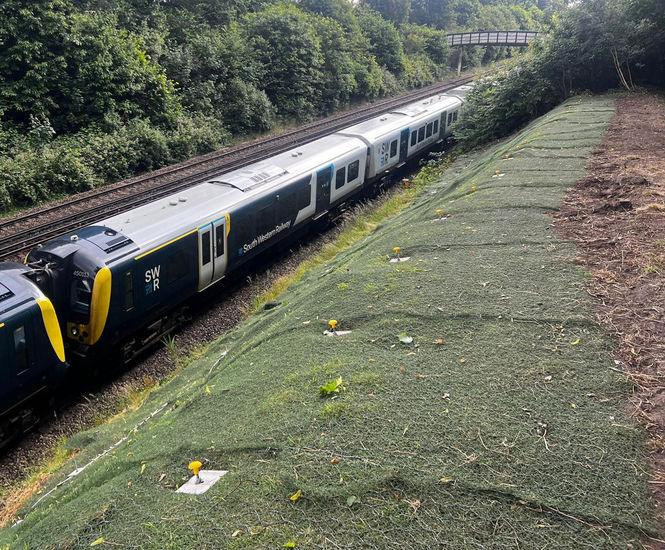
Movement detected by slope monitors along a 140m-long and 40m-high stretch of railway cutting in Hampshire. A speed restriction of 20mph was implemented, requiring an immediate solution to prevent further movement of the slope. Following the successful completion of phase 1, the second phase would stabilise this section of the cutting against erosion and future failures.
Solution
The line below remained open to railway traffic throughout work on the cutting, meaning access was only possible via the crest of the slope. Rope access was used to install the reinforced geomat and ground anchors on the 45 to 70° gradient slope face. A total of 770 Platipus anchors were installed to secure 4000m2 of geomat. Initially the geomat was anchored in a trench at the crest of the slope before teams abseiled down with handheld equipment to install the anchors. Each anchor was driven to a depth of 3m before being tensioned to a working load of 20kN, providing immediately-verifiable performance and creating intimate contact with the slope face to encourage vegetation growth.
Result
By using the Platipus solution only 2.7 tonnes of Embodied Carbon was emitted. Comparatively, the originally proposed drilled and grouted solution would have emitted 16.9 tonnes of Embodied Carbon. An overall saving of 14.1 tonnes of CO2e, or 84%, was achieved by using the Platipus Low Carbon Anchoring Solution (LCAS®).