

- Sector
- Transport infrastructure
- Services provided
- Product / system manufacture
- Product / system supply
- Project location
- Northern Ireland
- Client
- Belfast Harbour Authorities
- Dong Energy
- Scottish Power Renewables
- Consultant
- Doran Consulting
- Contractor
- Farrang Construction
- Products used
- ParaLink®
Context
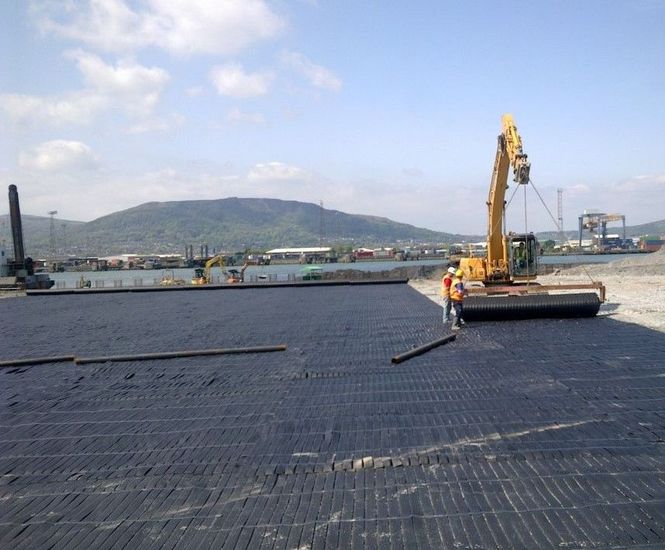
Maccaferri Paralink® basal reinforcement high-strength geogrids were used in the construction of a 480m-long new quay structure and deep water berth located in the Port of Belfast that required heavy use of geosynthetics.
Problem
Ground conditions at a 50-acre wasteland site at Belfast Harbour were so poor that a major programme of stabilisation and improvement was required to allow the construction of a £50m trans-shipment and storage facility required to support the offshore wind industry.
The riverside site, next to George Best Airport and close to the Titanic Quarter, is the largest in the Harbour’s 400-year history. The project was part of a joint venture between Dong Energy and Scottish Power Renewables to support the construction of the West of Duddon offshore wind farm.
Stabilisation and strengthening of the upper ground formations were needed as the facility was to be used for the off-loading, storage and assembly of huge wind turbine components. Large tracked cranes were used to move equipment and materials about the site and, at full capacity, imposed extreme loads on the surface.
The quay wall was constructed using a combi wall of 1600mm-dia, 32m-long tubes and 22mm sheet piles tied back and anchor beam supported on 376x 30m-long raking tubes. The 17,000m2 quay slab was also supported by 780x 750mm-dia CFA piles.
Solution
The works included dredging of the new berth and approaches. This involved the disposal of 500,000m3 of material to sea with treatment and disposal of some contaminated material to land. Behind the new quay, there are 50 acres of hinterland to receive heavy-duty unbound pavement involving the placement of more than 900,000m2 of geosynthetics and the import of circa 1,000,000 tonnes of aggregate.
With this in mind, engineers devised a scheme which involved surface build-up of up to 2m depth in places using a combination of site-won fill and over 250,000 tonnes of imported stone. This was placed in layers over an array of Maccaferri Paralink® basal reinforcement high-strength geogrid approximately 1.3m below the finished surface.