

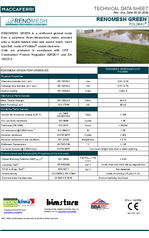
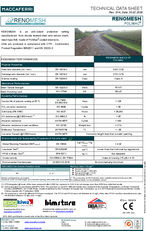
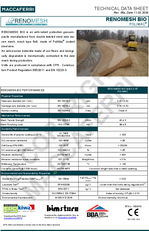
- Product name
- RenoMesh
- Application
- Animal / pest control
- Material
- High density polyethylene
- Roll size (l x w)
- Made to order
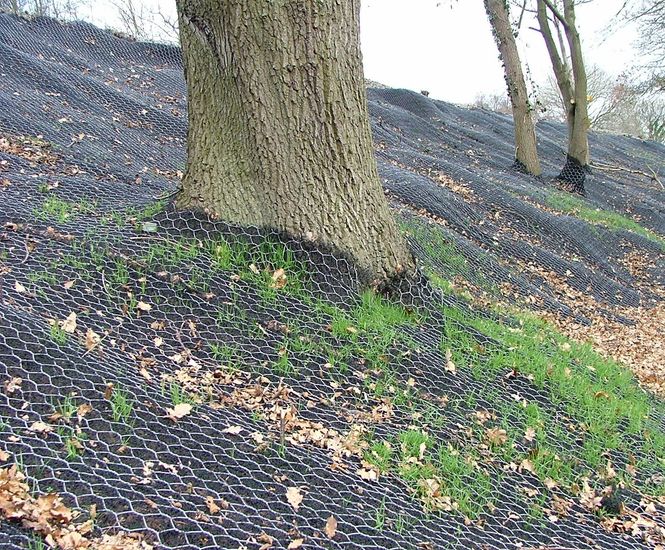
RenoMesh anti-burrowing mesh offers asset owners such as rail and highway authorities a cost-effective system that does not harm burrowing mammals. The mesh works as an effective long-term barrier against the intrusion, discouraging them from digging inside the levee core or embankment; the creatures then migrate to other non-critical areas of the river or infrastructure.
Beavers, badgers and other burrowing animals can damage embankments, slopes and dykes. Allowed to continue, the burrows enable storm water run-off or river water to penetrate deep into the embankment, weakening the soils, and thereby increasing the risk of slope failures.
Range
RenoMesh
Heavily galvanised steel wire mesh with Maccaferri's unique PoliMac polymeric coating. The polymer coating is important as the mesh is in constant contact with the ground / soil.
RenoMesh Green
As RenoMesh but with a 3D polymeric matrix extruded onto the wire mesh to provide immediate erosion control and support topsoil to enable the rapid revegetation of the slope.
RenoMesh Bio
As RenoMesh but with a biodegradable matting attached to the wire mesh to provide immediate erosion control of the slope and to facilitate revegetation.
Benefits
Steel stops burrowing effectively as it prevents biting.
Polymer-coated for 120-year design life.
BBA certified.
Butt connection with no overlapping – no material wastage.
Double twist mesh does not unravel when wires are damaged.
Easily cut and replaced around obstacles, eg tree stumps.
Surface reinforcement ensures embankment safety from high water levels.
Benefits of anti-burrowing mesh and the 3D polymer matrix
Erosion control which reduces irrigation / wash out of fine soil particles.
Aids vegetation, which is additional support for plant growth and creates wildlife habitats.
Easy to maintain and install.
High flexibility to adapt to uneven surfaces.
All RenoMesh anti-burrowing meshes are supplied in rolls for convenience. They are simply unrolled onto the ground to be protected and pinned down. The inherent flexibility of the mesh means it confirms the slope profile. The adjacent rolls of mesh can be rapidly connected using lacing wire, C-ring clips or the company's DT Links.
A proven solution
Studies conducted by the Technical University in Vienna (Austria) assessed how we could prevent these animals from burrowing into the critical core of an embankment along rivers in Europe. From the range of meshes trialled, the study concluded that the only way to create an effective barrier to the bite of beavers is to use steel wire mesh. In the past, synthetic materials were used, but the research concluded that they were ineffective against large rodent bites.
Importantly, RenoMesh Green and Bio solutions promote the establishment of vegetation, allowing integration into the environment. Recycled steel is used in the manufacture of the product, which also contributes to cutting CO2 emissions.
PART 1 – PRODUCT
1.1 DESCRIPTION
The anti-rodent protection geocomposite is a preassembled product made of double twisted wire mesh rolls mechanically coupled to an anti-erosion biotextile made of coir fibres. The units shall be manufactured in compliance with BS EN 10223-3, with Zn-Al alloy and a High Abrasion Resistant (PoliMac® or equivalent) polymer-coated steel wire.
The units are manufactured in compliance with The Construction Products (Amendment etc.)(EU Exit) Regulations 2020 on the basis of UKAD 230008-00-0106 and UKTA-0836-22/0022.
[For Republic of Ireland: The units are manufactured in accordance with Construction Product Regulation CPR 305/2011 and have a CE marking in compliance with EAD 230008-00-0106.]
The management and production system of the supplier shall be certified in compliance with ISO 9001.
All listed performances must be verifiable on laboratory test reports conducted by independent research institutes, the relevant documentation shall be submitted to the supervisor for the acceptance of the material
1.2 FUNCTIONAL CHARACTERISTICS
The tensile strength of the steel wire mesh shall be 40 ± 3 kN/m, in accordance with BS EN 10223-3.
The punch resistance of the steel wire mesh shall be 48 ± 5 kN; tests on a 3x3m sample are laterally constrained following the EAD 200026-00-0102 and ISO 17746 test methodology.
1.3 MATERIALS
The double twisted steel wire mesh shall be manufactured with 6x8 mesh type (BS EN 10223-3, Table 2), woven with a drawn steel wire core of 2.20 mm in diameter, with a minimum quantity of 230 g/m2 of Zn-Al metallic coated alloy, in accordance with ISO 7989-2 and BS EN 10244-2, Table 2, Class A.
The double twisted steel wire mesh shall be resistant to outwearing accelerated ageing when subject to test in a Sulphur dioxide environment (ISO 22479): after 28 cycles of discontinuous test, the mesh shall not show more than 5% of DBR (Dark Brown Rust).
The metallic coated wire core shall be protected with a high abrasion-resistant polymer coating (PoliMac® or equivalent), with a nominal thickness of 0.5 mm, resulting in a nominal overall diameter of 3.20 mm.
The 100% coir fibres biotextile shall have a mass per unit area not lower than 700 g/m2 (EN ISO 9864), tensile strength (MD/CD) of 20/9 kN/m (BS EN ISO 10319) and coverage ratio greater than 60%.
1.4 POLYMER COATING
The polymer coating shall not contain heavy metals and be resistant to:
Outwearing accelerated ageing in salt spray (ISO 9227): after 15,000 hours of exposure, the mesh shall not show more than 5% of DBR (Dark Brown Rust).
Abrasion test, in accordance with the procedure described in ASTM A975-23: after 300 cycles the polymer coating shall not expose the metal wire.
UV radiation, in accordance with ISO 4892-3, type 1A: after 2,500 hours of exposure to QUV-A the tensile strength and elongation at break of the base compound shall not change more than 25% from the initial test results. The polymer coating shall not release phthalates during the degradation process.
The brittleness temperature shall be lower than -35°, tested in accordance with ASTM D746.
Corrosion spread test, in accordance with the procedure described in ASTM A975-23: the maximum corrosion length measured shall be always less than a mesh repetition on wire samples immersed in an acid solution with an unprotected end for 2500 hours.
1.5 LACING
The steel rings used for fastening operations shall be made of stainless steel and have the following characteristics:
Diameter: 3.00 mm
Tensile strength > 1,550 MPa
Pull-apart strength > 2.0 kN
1.6 ENVIRONMENTAL AND SUSTAINABILITY PROPERTIES
1.6.1 Environmental Product Declaration
The anti-rodent protection geocomposite (RenoMesh BIO®) units shall have a Type III Environmental Product Declaration (EPD) registered and certified in accordance with ISO 14025 and BS EN 15804, to evaluate the environmental impact and give the possibility to calculate the Life Cycle Assessment (LCA) of the designed technical solution.
Such sustainability performances/requirements have to be reported in the Type III EPD certificate; certifications of not authorised bodies or self-certificates issued by the manufacturer, are not allowed.
The value shall be declared, as per Table 1, in terms of Global Warming Potential (GWP 100 years) and expressed in kg CO2-Equiv./kg.
Table 1 – Environmental and sustainability properties |
|||
Global Warming Potential (GWP 100 years) |
ISO 14025 BS EN 15804 |
certified numeric value |
[kg CO2-Equiv./kg] |
1.6.2 Environmental Harmlessness
The polymer-coated steel wires shall be tested to ensure their Environmental Harmlessness according to the following procedures:
Synthetic Precipitation Leaching Procedure (SPLP) preparation as per EPA 1312 and Metals in Water by ICPMS (low level) as per EPA 6020B in which the presence or not of 31 different metals shall be analysed using atomic spectroscopy.
The results shall be in compliance with (a) Water Framework Directive 2000/60/EC; (b) CCME Water Quality Guidelines for the Protection of Aquatic Life, Freshwater; (c) U.S. EPA National Recommended Water Quality Criteria (Aquatic Life, Freshwater), 2006.
PFAS test in water by SPE/LCMS as per EPA 537.1 in which the presence or not of 28 different PFAS shall be analysed, showing that the polymer-coated steel wires are PFAS free. Resulting in a concentration lower than 2 ng/L of PFOS and PFOA and < 4 ng/L for other PFAS.
ELUATE Tests on environmental safeness, conducted as per M GEOK E:2016, shall ensure that the polymer coating is not critical for the environment.
Smoke toxicity tests conducted as per ISO 5659-2 and BS EN 17084 shall ensure a Gases Conventional Index of Toxicity after 8 minutes sampling CITG (8) < 0.10 and a HCl concentration < 36 ppm