

- Sector experience
- Leisure and hospitality
- Fountain / water feature experience
- Sculptural fountains
- Cascades / chutes
- Pools / rills
- Services
- Design
- Project management
- Pump / filter installation
- Computerised control
- Client
- Emily Estates
- Consultant
- Greenhalgh Landscape Design
- Contractor
- Ken Biggs Contractors; Gavin Jones Landscapes
Context
The Creamery at Castle Cary is a landmark heritage building, originally built in 1912 as a milk factory where local dairy was processed and transported by rail to London.
The restored building now operates as a high-quality food and drink venue for visitors and rail travellers, celebrating its rich industrial heritage through skilled craftsmanship.
The project was shortlisted for a RIBA South West & Wessex award. Waterscapes were appointed to design and install a distinctive water feature within the landscaped gardens, alongside a comprehensive automatic irrigation system to maintain the grounds year-round.
Project overview
The Creamery's restoration presented a rare opportunity to integrate contemporary water feature design with the building's distinctive heritage narrative.
Waterscapes worked closely with the architectural team at Stonewood Design and landscape contractor Gavin Jones to deliver an installation that serves both an aesthetic and functional purpose - a sculptural element that echoes the building's history while supporting the landscape and emergency services requirements.
The brief included two distinct elements:
a striking water feature for the landscaped gardens, designed to engage visitors and reference the building's heritage as a creamery
a comprehensive automatic irrigation system to establish sustainable landscape management across all planting areas.
Technical details
Water Feature Design
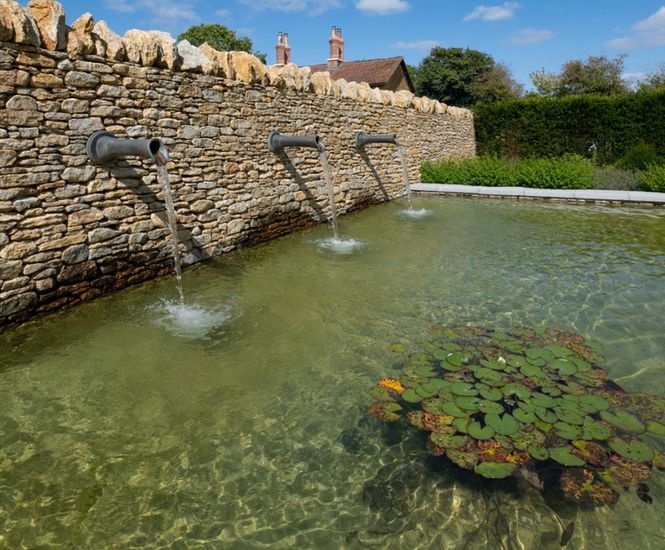
Three large bronze spouts, fabricated by Inspired Metal Ltd, form the centrepiece of the water feature. Designed to reflect the pouring movement of milk into vats during the creamery's working years, this sculptural concept transforms the building's industrial heritage into a living design element - when water flows through the spouts, it recreates the gesture and movement integral to the building's original purpose.
The spouts feed into an open body of water (pool/basin) that serves a dual function. Aesthetically, it creates a calm, reflective focal point within the gardens. Functionally, it is sized to provide a static water reserve for emergency services firefighting capabilities, ensuring the installation meets local safety requirements while maintaining visual appeal.
Water Circulation & Treatment
Water is drawn from an underground tank located near the garden edge and pumped through a circulation system that delivers water to the three bronze spouts.
After flowing through the spouts into the pool, water overflows through hidden bespoke openings positioned discreetly below the steps, before returning to the underground tank to complete the cycle.
An organic water treatment system maintains the quality and health of the circulated water.
The treatment process comprises three stages:
coarse pre-filtration to remove large particles
deep bed media filtration for fine sediment and debris removal
ultra-violet treatment to manage algae and microorganisms.
This multi-stage approach ensures the water remains clear and healthy without requiring chemical treatments, in keeping with the thoughtful design ethos of the project.
Landscape Irrigation
A fully automatic irrigation system was installed to manage planting across the landscaped grounds. The design employs different application methods suited to each area:
drip irrigation for trees and hedges, delivering water directly to the root zone with minimal waste
tall pop-up spray heads for hedge irrigation
low pop-up spray heads for lawn areas.
All zones are linked to a central controller, which integrates a rain sensor to adjust watering schedules based on weather conditions, optimising water use and reducing manual intervention.
Results & Outcomes
The Creamery now has a distinctive landscape water feature that serves as both a design focal point and a functional element rooted in the building's heritage.
The bronze spouts create a memorable visual and sensory experience - the sight and sound of flowing water references the building's industrial past while the pool provides practical value for emergency services access.
The automatic irrigation system has established a resilient, low-maintenance landscape management regime. Planting is watered efficiently and consistently, and the rain sensor ensures water use is responsive to seasonal conditions.
The combination of the heritage water feature and integrated irrigation demonstrates how contemporary design and technology can enhance a heritage building's landscape, supporting both visitor experience and long-term site stewardship.