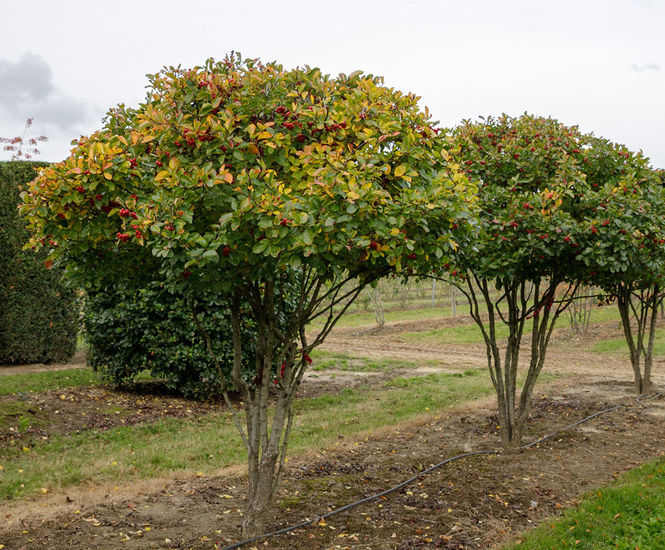


All the colours of autumn can be seen in the brilliant play of colours of Crataegus crusgalli and the small trees have their shiny yellow to orange-red leaves as early as September. The foliage color is a beautiful contrast to the red, often abundant fruit cover. The species, also known as cock's spur hawthorn or cock's thorn, can be easily cut into shape and grows into wonderful topiary trees. The German name refers to the up to 8 cm long, slightly curved thorns on its branches. This, in addition to its dense branches, makes it a perfect bird protection tree. Crataegus are adaptable and undemanding deep-rooted plants that prefer neutral to alkaline locations and like to be in sunny to semi-shady locations.
Main features
Height |
5 to 6 m |
Width |
3 to 5 m |
Flower colour |
White |
Flowering Time |
May, June |
Light / shadow demands |
light shade, no direct sunlight, sun |
pH-Value |
slightly alkaline, neutral, alkaline |
Soil |
loamy, tolerant of salt, permeable, all substrates |
Characteristics
Habit |
Small tree with very wide, flattened and compact crown, 5-6 m tall and 3-5 m wide; with many dense twigs, slow-growing to medium/fast-growing |
Crown |
flattened round, wide round, compact, picturesque flattened round, wide round, compact, picturesque |
Blossom |
White umbels after leaves shoot, May to June |
Leaves |
Broadly elliptical, shiny dark green; orange-red from September, brilliant autumn colours |
Fruits |
Round, attractive, scarlet, many fruit every year from September, persistent |
Roots |
Few twigs, deep roots |
Demands |
Adaptable and not demanding, sun to light shade, tolerant of heat, frost hardy; resistant to industrial and urban pollution, tolerates wind |
Soil |
Moderately dry to fresh, neutral to very alkaline, on all well drained substrates |
Hardiness Zone |
Zone 4 Also see chapter on topiary plants |
Bee pasture / nectar |
Yes |
Synonyms |
C. persimilis 'Splendens'; C. prunifolia 'Splendens' |