


- Sector
- Housing, private
- Project type
- New build
- Services provided
- Site survey
- Planning advice
- Design
- Product / system manufacture
- Product / system supply
- Project management
- Installation
- Year completed
- 2025
- Project location
- South East England
- Client
- Taylor Wimpey
- Products used
- Rootlok
Overview
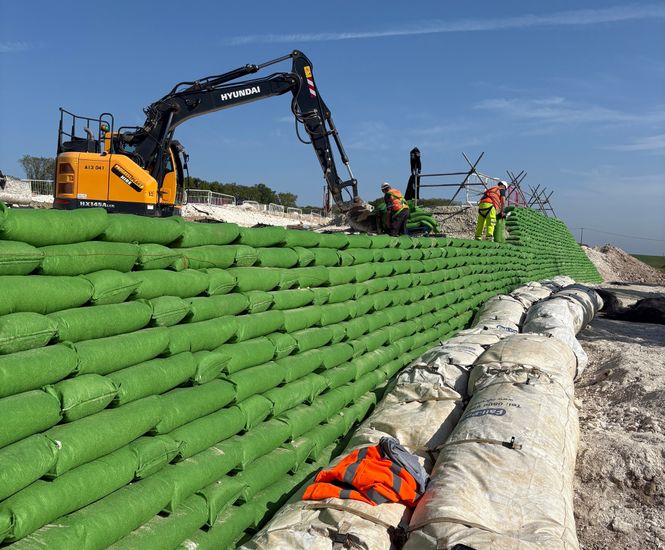
GeoGrow's Rootlok vegetated wall system was used to create two critical retaining walls at Capstone Oaks in Chatham, a new community of up to 800 homes with areas of open space and new community facilities.
Challenge
The client and contractor faced a number of significant challenges from the outset. Localised areas of high plasticity clay were present at surface level, creating a risk of instability and necessitating excavation and replacement with engineered fill in specific zones. At the site’s edge, space was extremely limited due to tree root protection zones and steep surrounding slopes, which made access and safe construction more difficult. Additionally, sequencing constraints meant that piling for adjacent plots had to take place after the retaining walls were built. This required careful modelling of temporary loads and precise coordination to ensure safe working conditions.
Solution
GeoGrow proposed a tailored solution using the Rootlok mechanically stabilised earth (MSE) wall system, which was particularly well-suited to the site’s limitations.
The first wall, measuring 100m long and 3m high, was designed to retain slopes around a SuDS basin.
The second, significantly longer at 225m, was installed to retain upfill and garden plots along the site boundary.
Both walls were essential to the site's infrastructure, with their design and construction needing to address numerous environmental and logistical constraints.
Where soft deposits were identified, these were selectively removed to improve ground stability without resorting to wholesale excavation. The design team also carried out temporary load modelling to assess the impact of piling operations on the completed walls.
From this, specific exclusion zones were established to control where equipment could operate and avoid placing excessive pressure on the newly constructed structures. The Rootlok system’s minimal footprint also allowed construction to take place safely within the tight confines of the site, protecting trees and minimising ecological disruption.
The construction phase was also challenging given the early stage of the overall site. The site had not been pre-upfilled, which meant the team had to develop a phased methodology to build the wall and upfill behind it simultaneously. This required close collaboration with the groundworks contractor to ensure backfill and wall construction progressed hand-in-hand. Time constraints added another layer of pressure, with an ambitious eight-week programme in place to allow piling to begin. To meet this deadline without compromising quality, GeoGrow doubled the size of its on-site workforce, enabling the team to maintain productivity and deliver the works on schedule.
Outcome
Both retaining walls were completed on time, and the subsequent piling operations behind the structures were carried out without issue.
In total, 325 linear metres of MSE walls were constructed, equating to over 975m2 of retained soil.
The project was delivered within budget and programme, with no damage to protected tree zones or nearby boundaries.
The success of the scheme highlighted the adaptability and strength of the Rootlok system, even under challenging conditions.
This project stands as a strong example of how thoughtful engineering, clear communication, and flexible installation methodologies can overcome complex site constraints and deliver lasting, effective infrastructure.
Once in their vegetated state, the walls will create an aesthetically-pleasing landscape while supporting biodiversity, wildlife habitats and sustainability.
Comments
“This job was particularly challenging from a design and construction perspective with lots of considerations that needed to be taken into account. It required collaboration from GeoGrow, the Principal Contractor and the Principal Designer, but in the end was successful.”
– Dan Roberts, Technical Director