

- Product name
- Hydrotrench®
- Materials
- Other
Hydrotrench® is manufactured in the UK from end-of-life rubber tyres, supporting environmental sustainability. The modular design, reduced trench size and high permeability of the system delivers a long-lasting solution for cycle paths, edges, landscapes, hard standings, paved areas and gardens.
The Hydrotrench® sustainable drainage system is supported by comprehensive technical specification documents, which include independently-verified hydraulic performance data and pipe size equivalents, which utilise the latest modelling software packages.
Features and benefits
Hydrotrench® has been designed to provide:
Long-lasting integrated drainage solutions
Reduced excavation, spoil management and carbon footprint benefits
Increased drainage connectivity, attenuation and climate change resilience options
Improved planning and construction approvals
Optimised land use, nature-based solutions, ecology preservation and Biodiversity Net Gains
How it works
Working back from outfall, a narrow trench network is excavated in the land and / or at edge lines to enable efficient installation of the system.
To complete installation, the trench is backfilled with native soil and / or finished with a free-flowing material / surface.
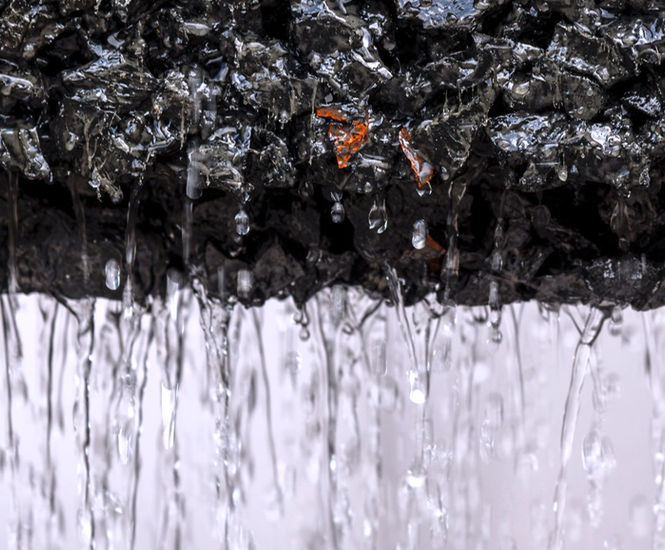
Water immediately enters down and into the void space of low-pressure created by the system, which is entirely porous on all sides (unlike a perforated pipe or channel drain).
These unique properties invoke more responsive and persistent drainage flows, significantly increasing value engineering and design options for effective water management.sign
Build
Intercept and efficiently remove surface water within:
- Constrained boundary lines / perimeters
- Crests and embankment toes
- Landscapes, public spaces and parks
- Gardens, driveways, paved areas and edges
- Pathways and vergesScale-up drainage designs to address any size of catchment using the large range recycled tyre rubber drainage panels, troughs and slab unit options available.
Connections available in a range of sizes for silt traps, chambers and catch pits.
Fully compatible with geotextile materials, geocomposites, impermeable membranes, and other water / soil / erosion control materials - use standard practices.
Technical
Porosity / void ratio: 45% (average)
Water permeability: 49 l/m2/s
Predicted design Life: 60+ years
Sufficiently durable in standard conditions and backfill when designed and installed as drainage partsResistance to chemicals: petrol, diesel, de-icer, salt - pass
No visual surface change or deterioration was observedToxicology and environmental: heavy metals, PAH, environmental safety – pass
Accreditations
International standard ISO 9001
ASTM C642: porosity/void ratio
ASTM D4065: water temperature resistance
BS EN ISO 604: compressive strength
BS EN ISO 11058: water permeability
BS EN ISO 12958: in-plane water flow
DEF STAN 00-035 Part 3: chemical resistance
NF P90-112: toxicology