


- Sector
- Housing, private
- Project type
- Refurbishment
- Services provided
- Planning advice
- Product / system manufacture
- Product / system supply
- Year completed
- 2024
- Project location
- West Midlands
- Client
- Private homeowner
- Products used
- Stepoc retaining wall
Overview
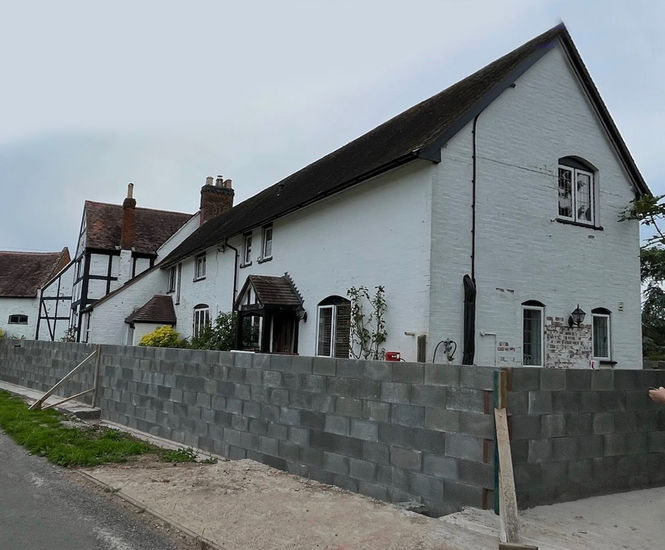
Ibstock's Stepoc precast concrete block retaining wall system has been used by a private homeowner as a flood defence solution for his property.
Context
Located on the banks of the River Severn, Nick Lupton’s converted 17th century house has been flooded 11 times since moving into the property in 2016.
With the area prone to flooding during periods of heavy rainfall, Nick knew he needed to take action to protect his property against further flood damage.
"Right from the moment we bought this house, we knew exactly what the flood risks were. We live in a very beautiful part of the world, right next to the River Severn, with one drawback - we get flooded. Having faced eight floods since 2019 alone, we finally decided to take action into our own hands and build ourselves a wall to protect our property."
Requirement
Self-built defences are common to some properties in the region due to its proximity to the Severn. Having considered some solutions utilised by neighbours – such as layered masonry which is tied together and filled with concrete – Nick wanted a product that was both hardy and reliable and, as he’d be completing the bulk of the build himself, easy to install.
Solution
Nick decided upon Stepoc, a precast concrete block retaining wall system which can be laid dry. Available in a range of sizes, Nick opted for Stepoc’s 200mm unit.
"One of the major appeals with Stepoc, for me, is that it provides both vertical and horizontal reinforcement, giving the product high levels of structural integrity – obviously key for effective flood defence."
In total, Nick required 110m2 of Stepoc blocks to build his protective wall, which ranges in height from 4 to 7 courses. To ensure the project was as cost-effective as possible, he elected to build most of the wall himself – working with a contractor only to lay the foundations and the first course. To this end, the relative simplicity of the Stepoc build process was another major selling point for Nick.
"Given the scale of the wall needed to protect the property, I knew that this wasn’t going to be an inexpensive project. That’s why, wherever possible, I was looking at ways I could economise without compromising on product quality. Thanks to Stepoc’s easy to install functionality, I was able to build much of the wall myself - a huge help in managing the spend on the project."
Nick, who purchased his Stepoc via Travis Perkins, also had access to Ibstock’s in-house team of technical experts and product datasheets, which provided him with in-depth insights to ensure he was specifying the best product for his requirements.
The build commenced in May 2023 and was completed in September, with testing via Storm Babet occurring just weeks later in October. In January 2024, the wall faced its greatest challenge yet when Storm Henk swept the country.
Nick said: "Almost as soon as the wall was finished, it was being tested by some extreme weather. The flood brought about by Storm Henk is one of the severest we’ve experienced since moving into this property, with water levels nearly exceeding the record flooding experienced in the area in 2020. This was a great test for the wall and, I’m happy to say, it has so far completely stood up to the challenge."
With more extreme rainfall, and therefore exacerbated risk of flooding, an increasingly common part of the British climate, investing in adequate flooding defence is a growing concern for property owners in vulnerable areas.
About Stepoc
Ibstock’s Stepoc retaining walls are uniquely designed to create a cascade effect which ensures a smooth filling of the pumped concrete, forcing out air and eliminating segregation to create walls which have immense compressive and lateral strength.