


- Product name
- POLYplank
- Material
- Recycled plastic
- Suitability
- Balconies
- Bridges
- Cycle routes
- Jetties
- Features
- Anti slip
- Support services
- Design
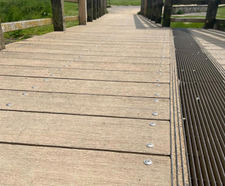
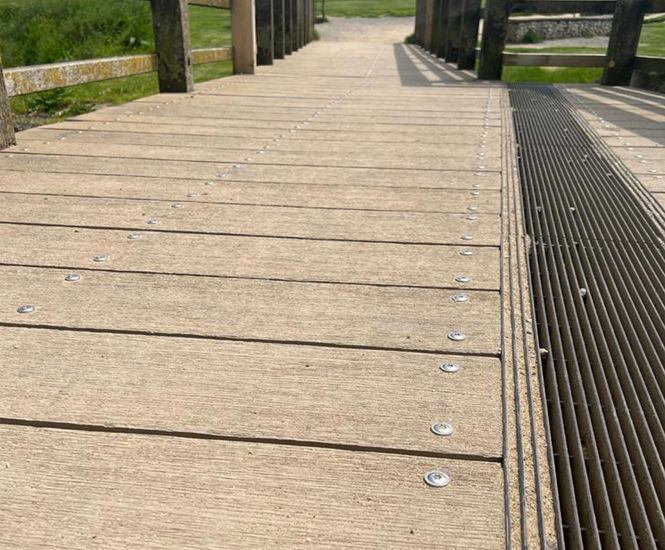
POLYdeck’s GRP decking planks have been designed to replace traditional timber planks which can be slippery when wet, and rot in a short space of time.
POLYplanks are made by combining a structural foam made from recycled plastic bottles encapsulated within a GRP outer layer. The product is made in a closed mould with an integral hard-wearing aggregate, to ensure a design life in excess of 75 years. Available in a range of colours and finishes, the planks will span up to 1200mm whilst achieving a pedestrian crowd load of 5kN per SqM UDL.
Features
Sizes
Comes in a range of standard lengths up to 3000mm long x 197mm deep x 45mm thick.
Lightweight
Made from lightweight GRP which makes sections easy to install on sites
Loading
Loading typically to 5KN per SQM UDL, at 1200mm centres. Higher loadings can be achieved, depending on bearer spacing
Made from GRP
Made from GRP in a thermoset process, so unlike re-cycled plastic options, our planks will not warp in hot weather.
Recycled Plastic Bottles
The structural foam core is made from 100% re-cycled plastic bottles. Every Square metre of foam removes 140 x 500ml plastic bottles from landfill.
Design Lines
Design life in excess of 75 years. Outlasts traditional timber decking by 10 times.
Slip Resistant
Slip Resistant walkway planks with PTV of ’92’ even when wet Low Slip Potential. Ensures the safety of pedestrians, cyclists and equestrian users.
POLYplanks incorporate the class leading, resin infused GRIPfast slip resistant finish.
A castellated finish on the planks provides channels along the length that allow water to drain from the surface to reduce icing in cold conditions.
Fixings
Polyplanks are designed to be fixed to timber supports with countersunk stainless steel screws.
When fixing to steel, use POLYplank resin bearers which are bolted to the top flange of the steel beam. Planks are then fixed into the resin bearers with drill screws. This reduces the number of drill holes into the steel which protects the structural integrity of the steel and also speeds up installation.
The ends of each plank can be cut on site using a small hand-held angle grinder with a diamond-tipped blade. The cut ends do not need to be resealed but can be painted if visible.