

- Project experience
- CFA bored piling
- Client
- Peel Ports Group
Context
Peel Ports Group invested £28million on a new facility at the Port of Liverpool. The new facility, referred to as Alexandra Dock Multi-User Warehouse (MUW), will be able to store a variety of commodities and will also have 300m of dedicated quayside and state-of-the-art cranes to optimise vessel discharge.
The construction of the 240,000sq ft warehouse is on a brownfield reclaimed docklands site. The warehouse is the length of five football pitches (400m) and will be used for the handling and storage of cargo at the port.
Challenge
Keller was contracted to provide a foundation solution through up to 15m of very low-strength made ground and low to moderate strength clays while minimising vibration and load shed onto the nearby dock wall.
The specified requirement for a very high slab loading of 100kN/m2 coupled with the presence of sandstone bedrock at the toe of the columns, generated high bending moment forces which warranted further consideration.
Keller's remit was to avoid a fully-piled and suspended solution for the whole structure which would have impacted the project cost and timescales and generated significant quantities of contaminated spoil and carbon.
Solution
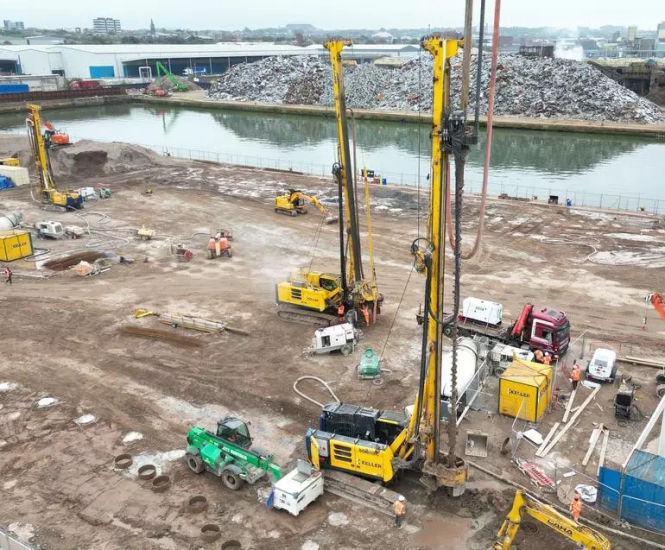
For the frame and crane base areas, which were subject to high axial, lateral and tensile loadings, a CFA piled solution was proposed. Keller installed around 1800 350mm-diameter CFA piles down to the sandstone bedrock strata at 15-19m depth. All piles were cage-reinforced and the crane base piles included a 900mm-diameter flared head. The flared head reduced the span between each pile and enabled a more efficient sub-structure design.
For the floor slab areas, around 5000 300mm-diameter rigid inclusions were constructed to lengths of up to 15m with the columns just toeing into the sandstone bedrock strata.
For the areas close to the dock wall, a no-vibration auger replacement (AR) method was used, and a suspended slab was adopted to avoid any load shed onto the dock wall. Each AR column was topped off with a 900mm-diameter enlarged head which served to reduce the shear forces as well as the spanning distance between the columns. This approach enabled the slab designer to reduce the thickness of the suspended slab.
For the remaining slab areas, a low-vibration auger displacement (AD) method was adopted to avoid spoil. Due to the very high slab loadings required and the presence of very low-strength strata just below the platform, a more innovative design was called for which would facilitate the adoption of a ground bearing slab. The combination of high loadings, very weak strata, and a sandstone toe was generating significant bending moment forces which needed to be reduced. Keller proposed the installation of a 750mm-diameter bulb and this was formed just below the 450mm-thick load distribution layer. The formation of the plug substantially reduced the bending moment so Keller could offer a ground bearing slab.
Result
The installation works were successfully completed in challenging ground conditions. Keller was able to hand over areas of the site while continuing with works to allow the main contractor to progress swiftly with the foundations.