


- Product name
- Maccaferri Gabion
- Functions
- Architectural
- Channel lining
- Erosion control
- Slope stabilisation
- Material
- Woven wire
- Finishes
- Galvanised
- Polyester powder coated
- Gabion shape
- Square
- Mesh shape
- Hexagonal
- Wire diameter (mm)
- 2.7
Gabions form one of the most cost-effective mass-gravity retaining structures. Their long-standing success is a testament to their longevity, simplicity of construction and robustness, characteristics first seen in the late 1800s when Maccaferri owned the patent for the original modern gabion.
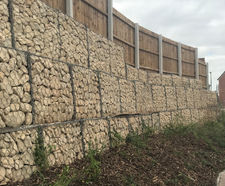
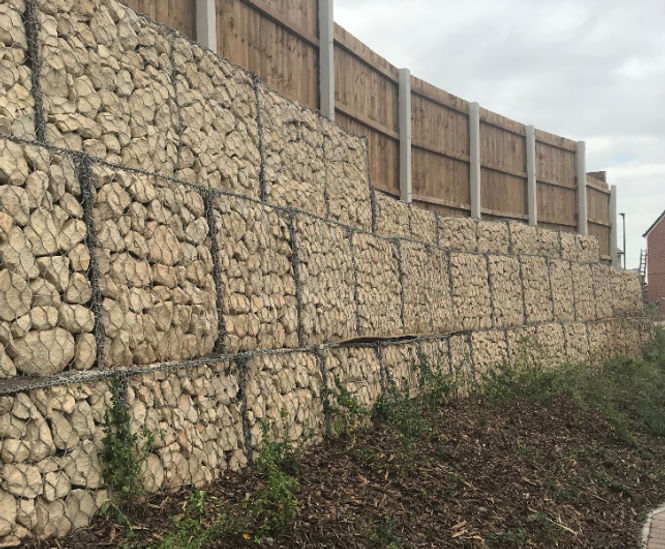
Maccaferri's Woven Gabion is a double-twisted wire mesh container of variable sizes uniformly partitioned into internal cells. They are interconnected with other similar units and filled with stone at the project site to form flexible, permeable, monolithic structures such as mass gravity walls, channel linings, revetments and weirs for geotechnical, hydraulic and erosion control projects.
What sets Maccaferri's gabion baskets apart are their high-quality manufacturing with 3rd-party certifications, heavy-duty galvanising, and the unique PoliMac polymeric coating.
Strongface gabions
Gabions can also be manufactured with thicker wire diameters, throughout the unit, or on discrete faces to ensure higher mechanical performance. Known as Strongface Gabions, these are used in environments where greater resistance is required.
PoliMac® polymer coating
PoliMac® is a unique new polymer coating for gabions and other Maccaferri steel wire mesh products. Developed to address the worsening environmental exposure conditions as a result of climate change, designers should be considering the climate conditions that their structures will be exposed to throughout its entire working life, not just the conditions of today. If the conditions of the future are expected to be worse than today, why take a chance? Futureproof gabions by using the PoliMac® coating.
PoliMac® is a revolutionary coating that can withstand aggressive environmental conditions, leading to a significant performance upgrade compared to other competitive polymer coatings. PoliMac® ensures:
10x better resistance to abrasion
2x better resistance to chemical aggression
4x better cold-weather performance
4x better resistance to UV rays
GSC concept
Maccaferri’s design software GAWAC 3.0 has been developed for the design and optimisation of gabion walls. Within it, the user will discover the 'GSC concept', an experimental coefficient that considers and evaluates the long-term performance of gabion structures.
GSC introduces:
Long-term performance at 120 years of service life
Experimentally tested and numerically verified method
Increased cost-effectivity of the design
Significant environmental benefits
The GSC approach combined with PoliMac® coated gabions leads to a reduction of the input material for the construction of the gabion wall and up 40% savings of CO2 emissions. Indeed, gabions enhance the biodiversification and the growth of vegetation within them, inducing CO2 sequestration. PoliMac-coated gabions have 10x less emissions than an equivalent concrete wall.
Maccaferri gabions reduce the total cost of ownership of the solution:
Material reduction: less stone means savings. Thanks to the GSC concept the amount of material needed to build a gabion wall is reduced.
More performance: PoliMac coating means outstanding performance in harsh conditions. It will preserve the structure, reducing maintenance costs.
Faster installation: material reduction means easier and faster installation. An optimised design increases the production rate.
Environment first: reduction of quarried stone means cutting the environmental burden.
Environmental product declaration
Maccaferri provides reliable and comparable information on the environmental impacts of the product life cycle, reducing energy and material consumption. The EPD Certification scheme is a third-party certified assessment of the emissions generated during the manufacture of its materials. They provide transparent data to enable clients and designers to compare solutions and products. These EPD Certificates are entirely specific to the specific Maccaferri manufacturing location: visit maccaferri.com/EPD.
PART 1 – PRODUCT
1.1 DESCRIPTION
Double twisted steel wire mesh gabions shall be manufactured in compliance with BS EN 10223-3, with Zn-Al alloy and a High Abrasion Resistant (Polimac® or equivalent) polymer-coated steel wire. Units are manufactured in compliance with The Construction Products (Amendment etc.)(EU Exit) Regulations 2020 on the basis of UKAD 200019-00-0102 and UKTA-0836-22/0019.
[For Republic of Ireland: The units are manufactured in accordance with Construction Product Regulation CPR 305/2011 and have a CE marking in compliance with EAD 200019-00-0102].?
The management and production system of the supplier shall be certified in compliance with ISO 9001.
All listed performances must be verifiable on laboratory test reports conducted by independent research institutes, the relevant documentation shall be submitted to the supervisor for the acceptance of the material.
1.2 FUNCTIONAL CHARACTERISTICS
In order to allow for the design at both Ultimate (ULS) and Serviceability (SLS) limit states, the gabion manufacturer shall provide the following characteristics:
Punch resistance of the wire mesh: tests on 1x1 m sample laterally constrained following the ASTM A975-23 test methodology;
Unconfined compression strength and displacement for gabion elements
Long-term (120 years) degradation effects on wire mesh due to chemical and environmental effects, installation damage, UV-ray exposure, and abrasion.
The tensile strength of the steel wire mesh shall be 55 ± 5 kN/m, in accordance with BS EN 10223-3.
1.3 MATERIALS
The double twisted steel wire mesh shall be manufactured with hexagonal 8x10 mesh type (BS EN 10223-3, Table 2), woven with a drawn steel wire core of 2.70 mm in diameter, with a minimum quantity of 245 g/m2 of Zn-Al metallic coated alloy, in accordance with ISO 7989-2 and BS EN 10244-2, Table 2, Class A.
The double twisted steel wire mesh shall be resistant to outwearing accelerated ageing when subject to test in Sulphur dioxide environment (ISO 22479): after 28 cycles of discontinuous test, the mesh shall not show more than 5% of DBR (Dark Brown Rust).
The metallic coated wire core shall be protected with a high abrasion-resistant polymer coating (Polimac® or equivalent), grey in colour, with a nominal thickness of 0.5 mm, resulting in a nominal overall diameter of 3.70 mm.
1.4 POLYMER COATING
The polymer coating shall not contain heavy metals and be resistant to:
Outwearing accelerated ageing in salt spray (ISO 9227): after 15,000 hours of exposure, the mesh shall not show more than 5% of DBR (Dark Brown Rust).
Abrasion test, in accordance with the procedure described in ASTM A975-23: after 400 cycles the polymer coating shall not expose the metal wire.
UV radiation, in accordance with ISO 4892-3, type 1A: after 2,500 hours of exposure to QUV-A the tensile strength and elongation at break of the base compound shall not change more than 25% from the initial test results. The polymer coating shall not release phthalates during the degradation process.
The brittleness temperature shall be lower than -35°, tested in accordance with ASTM D746.
Corrosion spread test, in accordance with the procedure described in ASTM A975-23: the maximum corrosion length measured shall be always less than a mesh repetition on wire samples immersed in an acid solution with an unprotected end for 2500 hours.
1.5 LACING
Stainless steel rings shall be used for fastening operations and shall have the following characteristics:
Diameter: 3.00 mm
Tensile strength > 1,550 MPa
Pull-apart strength > 2.0 kN
1.6 ENVIRONMENTAL AND SUSTAINABILITY PROPERTIES
1.6.1 Environmental Product Declaration
The gabion units shall have a Type III Environmental Product Declaration (EPD) registered and certified in accordance with ISO 14025 and BS EN 15804, to evaluate the environmental impact and give the possibility to calculate the Life Cycle Assessment (LCA) of the designed technical solution.
Such sustainability performances/requirements have to be reported in the Type III EPD certificate; certifications of not authorised bodies or self-certificates issued by the manufacturer, are not allowed.
The value shall be declared, as per Table 1, in terms of Global Warming Potential (GWP 100 years) and expressed in kg CO2-Equiv./kg.
Table 1 – Environmental and sustainability properties |
|||
Global Warming Potential (GWP 100 years) |
ISO 14025 BS EN 15804 |
certified numeric value |
[kg CO2-Equiv./kg] |
1.6.2 Environmental Harmlessness
The polymer-coated steel wires shall be tested to ensure their Environmental Harmlessness according to the following procedures:
Synthetic Precipitation Leaching Procedure (SPLP) preparation as per EPA 1312 and Metals in Water by ICPMS (low level) as per EPA 6020B in which the presence or not of 31 different metals shall be analysed using atomic spectroscopy.
The results shall be in compliance with (a) Water Framework Directive 2000/60/EC; (b) CCME Water Quality Guidelines for the Protection of Aquatic Life, Freshwater; (c) U.S. EPA National Recommended Water Quality Criteria (Aquatic Life, Freshwater), 2006.
PFAS test in water by SPE/LCMS as per EPA 537.1 in which the presence or not of 28 different PFAS shall be analysed, showing that the polymer-coated steel wires are PFAS free. Resulting in a concentration lower than 2 ng/L of PFOS and PFOA and < 4 ng/L for other PFAS.
ELUATE Tests on environmental safeness, conducted as per M GEOK E:2016, shall ensure that the polymer coating is not critical for the environment.
Smoke toxicity tests conducted as per ISO 5659-2 and BS EN 17084 shall ensure a Gases Conventional Index of Toxicity after 8 minutes sampling CITG (8) < 0.10 and a HCl concentration < 36 ppm
PART 2 – EXECUTION
The product’s conformity shall be certified by a third-party Notified Body, according to the The Construction Products (Amendment etc.)(EU Exit) Regulations 2020, which shall assess the quality control process at the supplier’s production facility.?
[For Republic of Ireland: The product’s conformity shall be certified by a third party Notified Body, according to CPR 305/2011, who shall assess the quality control process at the supplier’s production facility. Prior to the installation, and on each consignment of gabion units to the job site, the contractor shall provide the Supervisory Body with the relevant documentation (Declaration of Performance, D.o.P.) in original form, where product and supplier names, quantities and destination are specified.]?
Once gabion units are assembled and the foundation has been prepared, pre-assembled units shall be placed in position empty and shall be tied or fastened to adjacent gabions along all containing edges in order to form a continuously connected, monolithic structural unit. All connections shall be in accordance with BS EN 10223-3; then filling operations, both mechanical and manual, may start.
The stone fill material shall be provided in the proper sizes and quality. Rocks shall be hard, angular to round, durable and of such quality that they shall not disintegrate on exposure to water or weathering during the life of the structure. When placing the stones, care shall be taken to ensure that the polymer coating is not damaged.
After a layer of rock has been placed in the cell, sufficient hand manipulation of the rock shall be performed to minimise voids and achieve a maximum density of rock in the gabion. Bracing wires should be installed at the intervals recommended by the gabion supplier. Rocks in exposed vertical faces shall be hand-placed to reduce voids on the outer face. Units shall be overfilled to approximately 25-40 mm to allow for natural settlement.