
- Project experience
- Structural stabilisation
- Client
- Legal & General Assurance Ltd
- Contractor
- Main contractor: Harmonix Construction Ltd
Overview
A tricky problem of constructing a 27,000 sq ft warehouse on the site of an existing office block development, next to live services and a sewer was dealt with using with a combined low-vibration Rigid Inclusions and King Post Wall solution from Keller, which was approved by Thames Water.
Challenge
The main challenge was to provide a foundation and retaining wall solution through up to 4m of made ground and low-strength clays while minimising vibration onto adjacent live services, which included a large-diameter Thames Water sewer.
Main contractor, Harmonix Construction Ltd, was also keen to avoid fully suspended construction and to adopt a retaining solution that maximised the building curtilage.
Solution
Retaining wall
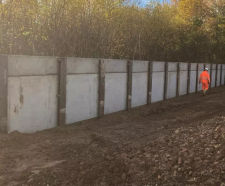
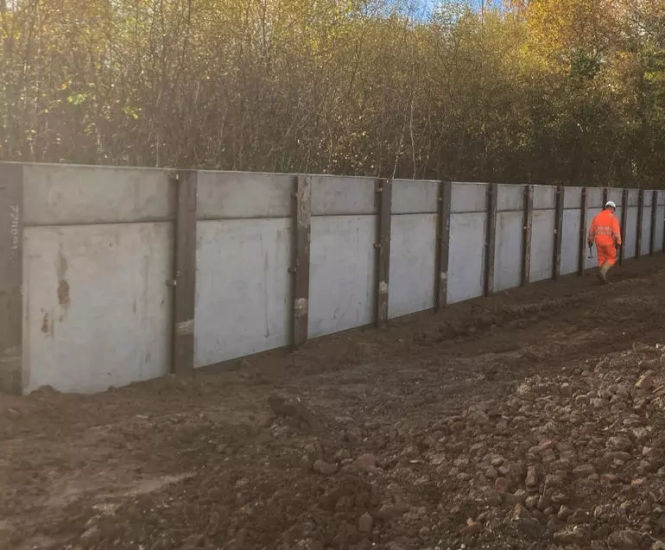
43 UC sections 256 x 256 x 89 were installed to lengths of up to 9m and drilled using low vibration CFA methods. The installation works were carried out using a smaller rotary rig which enabled Keller to access positions tight to the site boundary. The posts were completed in a little over a week with the panels inserted at a later date.
Foundations
429 circa 10.5m-long x 300mm-diameter unreinforced RIs were installed using cast in-situ construction methods. The installation works were designed to achieve 175kN/m2 beneath the foundations and 50kN/m2 beneath the floor slab areas of the proposed warehouse.
The main consideration for the foundation solution was the presence of a sensitive circa 10m-deep x 1200mm-diameter Thames Water sewer, located just 3m away from the proposed building.
Keller adopted a vibration-free auger replacement method of installation for these works to avoid the risk associated with heave and vibration and to secure the approval of Thames Water.
The installation works were completed in a little over two weeks and facilitated rapid follow-on works comprising simple reinforced shallow foundations which could be excavated while the RI columns were fresh.
Slab areas
Keller installed and cropped the columns to permit the installation of a ground-bearing floor slab which could be cast directly onto the rolled and compacted surface of the load distribution layer, all designed by Keller.