
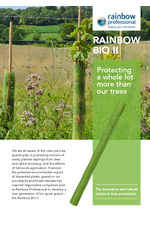
- Product name
- Rainbow Bio 1
- Characteristics
- Biodegradable
- Shape
- Round
- Colours
- Green
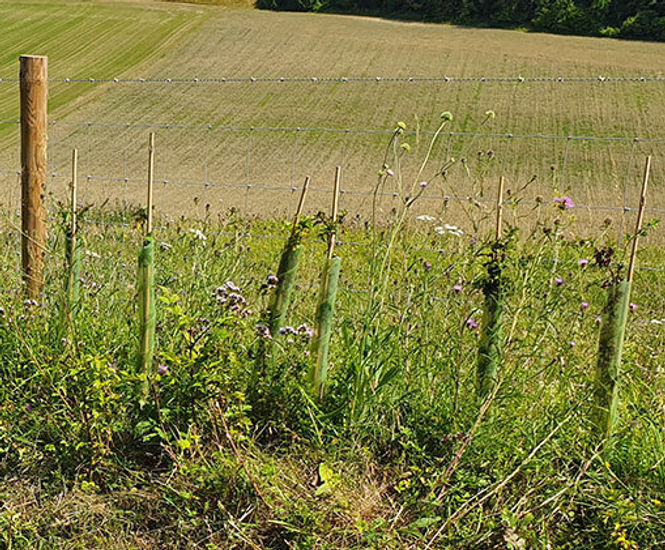
Originally launched in the 1960s, the Rainbow Spiral Guard offers an effective solution for seedling protection that stands up to all weather conditions, does not shrink and allows air circulation through its pre-formed holes. The product is easy to install and protects trees against herbicides drifting in the wind, offering more flexibility, efficiency and effectiveness of weed control.
Rainbow has now developed its first bio-based tree spiral, ‘Rainbow Bio 1’ that has passed all required tests against EU guidelines at an independent laboratory and is classed as fully compostable. The spiral has also gained the DIN CERTO certificate. Over the last three years, the Rainbow Bio 1 has been field tested in several trials across the UK and Europe. This has resulted in a product that is suitable to last for over 3 years at the typical range of temperature extremes that have been found in forests.
Environmental benefits
The Rainbow Bio-spiral offers a significant improvement on products made from conventional plastics; however, Rainbow also recognizes there is a great deal over confusion about innovations in plastics.
This can in part be attributed to legislation being heavily geared toward the packaging industry. The Rainbow Bio Spiral is made from 100% plant-based, biodegradable, non-toxic polymers; however, the finished product cannot be classed as biodegradable but should be classed as bio-based and compostable. Rainbow encourages all stakeholders to adopt this terminology. The key difference lies in the fact that products classed as biodegradable need to degrade within six months, making the product not fit for purpose.
Key benefits
- Fit for purpose: Rainbow has invested significantly in developing its raw material formulation and way of processing to develop a product that is designed to last at least 3 years.
- 100% plant-based: the Rainbow Bio 1 consists of only non-toxic resources, namely PLA and biodegradable additives. Given that PLA / Polylactic acid is made from plants (waste from beets and corn), we are now effectively put plants around our trees instead of products made from oil, which pollute the environment when they break down.
- Degradable: Rainbow’s spirals are 100% degradable. When inserted in an industrial composting unit, they will degrade within 6 months. When left in the environment, they will degrade over time, either through bacteria found in compost and soil or due to enzymatic reactions.
- Less harmful in the oceans: the product has a higher molecular weight, therefore sinking in water instead of floating. This makes it much less likely that the spirals could find their way into ocean extremes and reduces the threat to wildlife.
- Widely used and recommended by various bodies: PLA is the fastest growing biopolymer today, and widely used in other applications. In the packaging industry for example, a UK plastics pact was signed in February 2020 recommending the use of compostable plastics in applications where recycling is difficult. In the medical industry, PLA is the most used biodegradable polymer in clinical applications today.