
- Sector
- Transport infrastructure
- Project type
- New build
- Services provided
- Site survey
- Planning advice
- Design
- Project management
- Installation
- Year completed
- 2014
- Project location
- North West England
- Contractor
- CTS Bridges
Challenge
The Islington Bridge was conceived as part of a regeneration project near Murrays Mill at Ancoats, one of the largest remaining mill buildings in Manchester that forms an impressive red brick backdrop to the site.
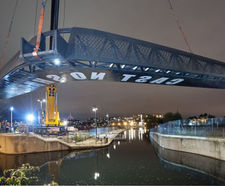
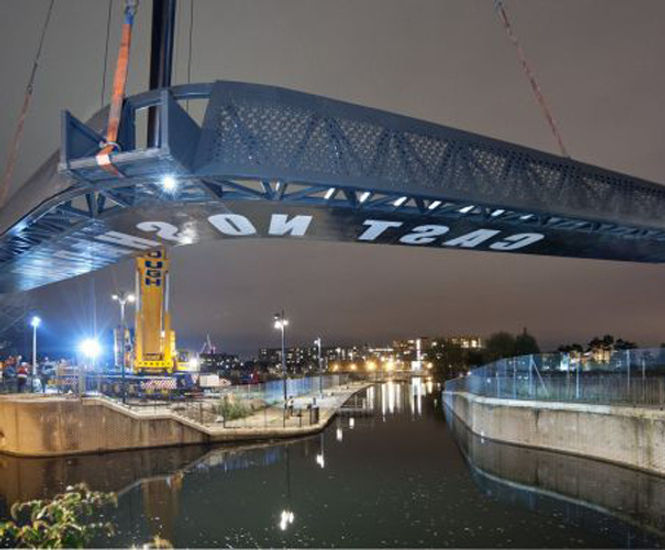
The bridge concept was the result of a RIBA competition run by Urban Splash in 2008. The brief was to connect three footpaths coming from different directions and at differing levels. The successful solution by Golifer Langston Architects and Michael Hadi Associates Consulting Engineers, achieved this by utlising a curved boomerang shape to connect the three access points. To reflect Manchester's urban culture the words 'Cast No Shadow' were stencilled to the underside of the bridge; the title of an Oasis song written by Noel Gallagher for the album 'What's the Story Morning Glory'. The intention was that the words would be reflected in the water below the bridge.
Unfortunately, following its completion, Manchester City Council raised concerns about health and safety and the bridge was never opened to the public.
Solution
To remedy the situation, CTS Bridges was approached to design, build and install a replacement structure. The brief was to ensure the new structure fitted within the existing architectural envelope and re-used existing steel cladding panels which incorporated a laser-cut motif to represent woven fabric.
Along with the aesthetic requirements, buildability and safe installation were critical to the new design strategy.
Attention to detail during both design and fabrication was important to ensure a successful structure. The anticipated rotation of the torsion space truss was carefully analysed to enable factory preset of cantilevering deck elements and every cladding panel was match fitted in CTS's factory onto the fully assembled structure to ensure the best possible fit with the constraints of the existing panels.
The large boomerang shape of the bridge meant it had to be transported to site in three sections and welded adjacent to the final bridge setting. Adjacent access roads limited crane size to a 500t capacity crane.
The combination of a large, heavy structure and restricted lifting capability created a challenging installation. As such, careful sequential activities were planned to ensure a safe, smooth installation. A high level of prefabrication was needed both prior to delivery and the final lift to avoid temporary works and working over water.
A precision planned lift which utilised the structure's centre of gravity, which fell outside the footprint of the deck, located all three landing points simultaneously with ease.
The entire lift was completed in under two hours by CTS's own on-site team.
Outcome
The new replacement bridge structure was approved by Manchester City Council and was opened once adjacent footpath works were complete.