

- Type
- Mechanical anchors
- Composition
- Aluminium
- Substrates
- Earth
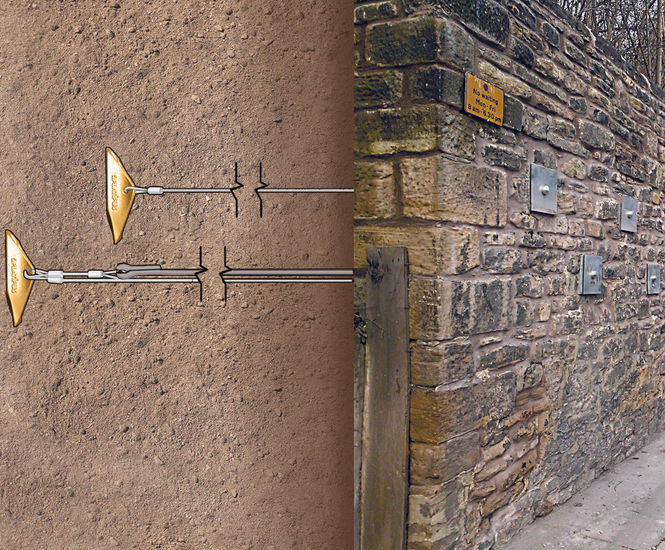
Platipus mechanical earth anchors are versatile products that can be rapidly deployed in most displaceable ground conditions.
They create minimal disturbance of the soil during installation, can be stressed to an exact holding capacity and made fully operational immediately.
As a completely dry system, they have minimal environmental impact.
Key features
Lightweight and corrosion resistant
Fast and easy to install
Immediate quantifiable loads
Holding capacity up to 200kN
Cost effective alternative to traditional anchoring techniques
Applications
Retaining walls
Slope stabilisation and erosion control
Bridge repair and construction
Sheet piling
Gabion support
Rock retention
Buoyancy control
Pipeline anchoring
Guyed structures
Landfill capping
General security
Marine applications
Tunnel linings
Product options
Anchors
Stealth Anchors are designed for lightweight anchoring applications with typical loadings up to 40kN.
Bat Anchors cater for higher loads with typical loadings from 20 to 200kN. Bat Anchors are also used to enhance anchoring in soft, cohesive soils.
Wire tendons and solid rods
Wire tendons and rods are available in a range of sizes and materials to suit temporary (up to 5 year) through to permanent (120 year) design life.
Round strand wire rods tend to be used in applications requiring lower loads and in areas where access and space is restricted.
High yield solid rods can provide a higher ultimate load, sacrificial corrosion resistance and allow the depth of installation to be varied on-site.
Top fittings
Top fittings are available to suit most applications and budgets, including:
Load bearing plate and wedge grip – a low cost solution for installations that are perpendicular to an application.
Tilt washers for angled installations.
Where finished appearance is important, a near flush fitting load plate that accepts a recessed wedge grip and cap or an inverted pattress plate which includes a hemispherical washer to allow the angle of anchor installation to vary between 0°-30°.
Top fittings specifically designed for revetment blocks and reinforced geomesh.
Soft and hard eye terminations to secure guyed structures and scaffolding.
Installation
Anchors are installed using a three step process:
1. Anchors are mechanically driven using simple hand or power tools
2. Rods are removed
3. The load is applied to rotate the anchor into its loadlocked position.
A wide range of hire equipment is available to install and proof test systems.
A supply and installation service through is available through a network of approved Installers.
Technical support
Design assistance including full indemnification
Site surveys and anchor testing
On-site training and demonstration
Anchor specification software and additional information is available online