



- Product code
- S0003 / S0008
- Products
- Belisha beacons
- Light source
- Solar powered
- Energy source
- LED
- Expected life (hours)
- 100,000
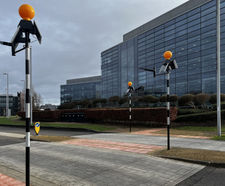
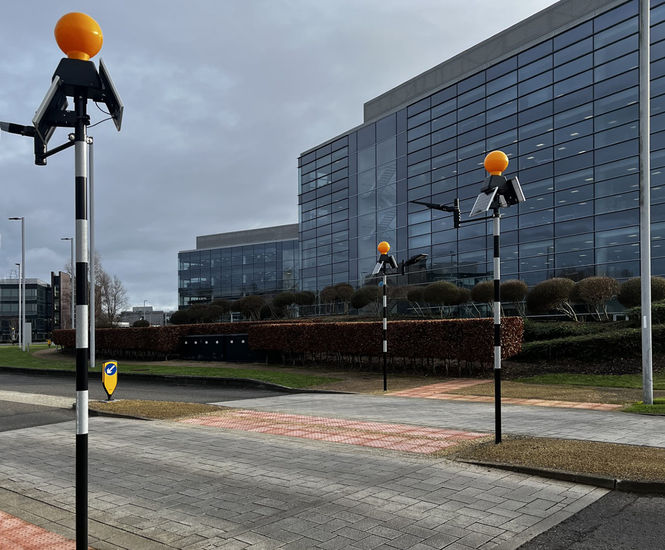
Street Furnishings' fully solar-powered Belisha beacon enhances pedestrian crossing safety across the UK, especially in winter.
Features
- Automatically operates 24/7 throughout the year.
- Proprietary Maximum Power Point Tracking (MPPT) charge controller with charge profile designed specifically for the TS2509A Mk3 beacon battery. This combination is twice as efficient as conventional (PWM) chargers and lead batteries which provides even longer autonomy.
- Body and globe made of vandal-proof, high UV-resistant polyethylene. Minimum maintenance required.
- Complies with IP54, EMC (BS EN55032) and CE standards.
- Osram LED bulb (L80B10 - 100,000 hours) with the Ambient Light Sensor (ALS) feature built into the bulb. This adapts the bulb's brightness to the human eye according to the external light conditions (not just auto-dimming at night) - patented.
- Lithium lead-free, environmentally-friendly battery that can be re-charged 3000 times, compared to only 500 times for lead batteries.
- Zero energy consumption and CO2 emissions following installation.
- Cost-effective replacement for faulty mains beacons eg due to cable faults.
- Total weight 8.5kg (including batteries and solar panel).
Warranty
- Beacon - 3 years
- LED bulb - 10 years
- Solar panel - 15 years
Optional extras
- Additional solar panel kit: clients should check that visibility east to west looking to the south from the installation location is unobstructed as the beacons operate on direct sunlight. If it is obstructed the TS2509 additional solar panel kit will overcome the lack of sunlight. The TS2509 is also recommended for all locations north of 53.5 degrees latitude.
- Intelligent timer module: enables the beacon to only operate during the times a business is open, reducing light pollution and pacifying residential neighbours.
- Globe shroud: for installations within or near residential areas. The shroud partially covers the globe, reducing light pollution and pacifying residential neighbours.
Installation
During installation, the solar panel is best placed facing the most southerly aspect available to ensure it can harvest the most energy during the day from the sun's rays.
Should the position of the crossing not present the ideal uninterrupted southern facing aspect for the solar cell it would be advisable to incorporate a second solar cell to ensure sufficient charge is obtained. This is especially important for more northern parts of the UK and during the winter months where the days are shorter with less opportunity to charge the battery.
Large savings can be made during installation as no wiring is required and there is less disruption whilst installation takes place.