

- Sector
- Public realm
- Project type
- New build
- Services provided
- Product / system manufacture
- Year completed
- 2026
- Project location
- London
- Client
- BALI (British Association of Landscape Industries)
- Consultant
- Matt Evans, The Garden Room Living and Landscape
- Contractor
- Frosts Landscapes
- Products used
- Hive
Chelsea Flower Show Garden 2026
A collaboration with BALI, The Garden Room Living and Landscape Studio, and Frost Landscapes
The brief
When BALI invited members to collaborate on a Chelsea Flower Show garden in early 2026, we were already planning the launch for Hive, our new modular seating and planting system. The garden's brief, biodiversity, climate resilience, the social value of outdoor space, mapped directly onto what the product was designed to do. The decision to get involved was immediate.
The garden was designed by Matt Evans of The Garden Room Living and Landscape Studio and built by Frosts Landscapes. It functioned simultaneously as a working trade stand for BALI's advocacy activity throughout show week and as a public demonstration of what considered landscape specification looks like in practice. Alongside Hive, Furnitubes' solar-powered charging bench Veeva Sol was also installed on the stand - a natural fit for a space making the case for future-facing public realm design.
Hive: the product
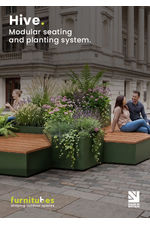
Hive is the latest step in Furnitubes' modular design thinking. The RailRoad range brought modularity along a linear plane; Uniun shifted forms outward. Hive takes the next step, using a hexagonal system that spreads outward and builds upward, varying seat heights and planter volumes within the same design language, so seating and greenery share a coherent form rather than sitting alongside each other as separate elements.
The geometry does practical work. Hexagons pack together without dead space, create natural gathering points, and allow configurations to read as intentional whatever their size. A four-module cluster anchors a small town square; a thirty-module arrangement fills a plaza. The same components, the same fixings, a different footprint.
For landscape architects and specifiers working within tight or phased budgets, this matters: "You can start with a smaller configuration and extend as funding allows," said Catherine Barrett, Managing Director of Furnitubes. "When the brief changes, Hive can change with it. This level of flexibility, without the bespoke price tag, changes what's possible for a lot of schemes."
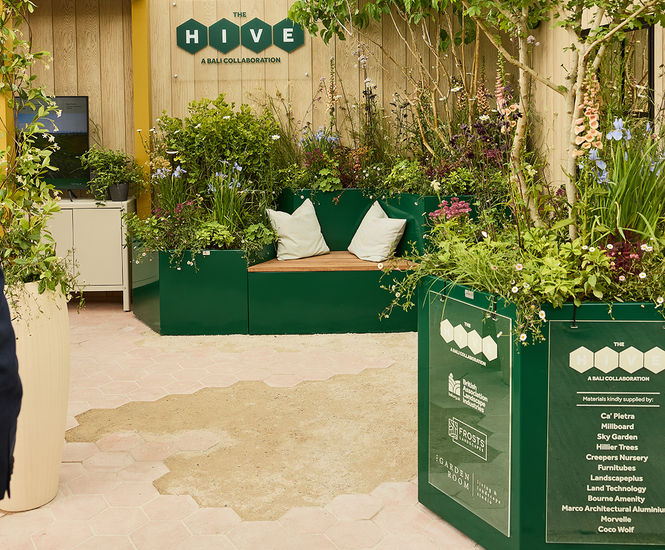
The name of the garden was no coincidence. The hexagonal motif runs through everything: the Hive modules themselves, the ground-level tiling chosen for the stand, even the pollinator-friendly planting palette that underpins the climate resilience brief. Each element arrived independently and pointed in the same direction. That kind of coherence is hard to plan - it tends to happen when the right people are working from the same values.
The Chelsea installation
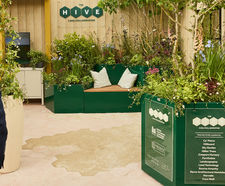
The stand was not large, not much bigger than a meeting room, as Matt Evans noted. He worked from a confirmed product list and designed the Hive configuration to give the space a sense of enclosure, drawing visitors in. The planting, grown specifically for Chelsea with climate-resilient species, had volume because the planter heights gave it room. The result was a space where people stopped, sat down, and stayed.
"I would like them to first think that the space was somewhere they wanted to spend time," said Evans, "because that's why we all do what we do. We create space for people to stop, slow down, think, engage with nature within the built space."
For Amy Cobbett, Head of Policy and Public Affairs at BALI, the garden was also making an argument to the policymakers and government officials moving through the show: "The aim was to create a visual representation of just a few of the benefits that the industry can bring."
On collaboration
Chelsea gave Hive something a product launch cannot manufacture: a fully planted, publicly accessible setting, designed by someone who understood both the brief and the product. As Catherine Barrett reflected: "Our products leave our factory empty, wrapped in bubble wrap, ready to go and have a life of their own. To see them brought to life with the planting, at an event like this, is something we're really grateful for."
When it all comes together, as Barrett put it, "someone gets to take a break under a small tree or among wildflowers in the middle of a city street. This is what we love about what we do."
Materials and sustainability
Hive is available in FSC-certified Iroko and Endura® thermally modified ash - grown and thermally modified in the UK, with the durability of a tropical hardwood. Steel components are triple-process powder coated, produced with approximately 80% recycled steel content. The Furnitubes factory runs on renewable electricity.