

- Sector
- Transport infrastructure
- Project type
- Refurbishment
- Services provided
- Product / system manufacture
- Product / system supply
- Year completed
- 2026
- Project location
- Wales
- Client
- Neath Port Talbot County Borough Council
- Products used
- Kerb collection
- StormSed treatment
- Q-Brake flow control
- StormBrixx attenuation
- Bespoke tanks
As part of the wider A483 Fabian Way dual carriageway improvements, ACO Technologies was tasked with alleviating a recurring road flooding issue that often made parts of the road impassable during heavy rainfall. Working closely with Neath Port Talbot County Borough Council, ACO provided its expertise to design a drainage system that overcame a series of challenging complications.
The site is a Site of Special Scientific Interest (SSSI) project, meaning the impact on the vulnerable surrounding wetlands was taken into careful consideration where Neath Port Talbot CC and ACO worked with Natural Resources Wales (NRW) throughout the project to ensure any road run-off released from the drainage system was treated to a high level.
The need for change
Prior to the redevelopment project, the existing drainage system, primarily conventional gully pots and soakaways in the central reservation, was failing and causing frequent flooding. This had a severe impact on the main approach road to Swansea, with persistent flooding compromising the university’s key access route as well as affecting the area’s primary motorway entry point.
The section of the A483 near Fabian Way had been prone to severe flooding for several years, but its proximity to the River Neath wetlands – part of a designated SSSI – meant the solution had to do far more than manage surface water volumes. Any run-off discharged through the established pipe network, which drains into the surrounding marshland before reaching Swansea Bay, had to meet enhanced pollution mitigation requirements set out by Neath Port Talbot CC and NRW.
Because the existing infrastructure could not be altered, ACO needed to design a system that delivered enhanced treatment performance while integrating seamlessly with the pipework present on the site. Other obstacles also provided a challenge, including lighting and signage in the central reservation which could not be removed for installation.
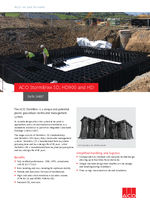
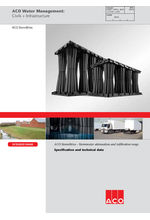
This balancing act formed the core challenge of the scheme and led to ACO’s decision to use custom StormBrixx attenuation tanks. These were shallower, thinner and longer than typical tanks, to account for the space restrictions of the central reservation.
“From the outset, it was clear that this wasn’t just a hydraulic challenge – it was an environmental one,” said Martin Smith, Regional Specification Manager at ACO. “We had to ensure the solution improved road safety by stopping the repeated flooding, while also protecting a habitat of national importance. Achieving that required technical precision, collaborative planning and the right treatment technology.”
Collaborative design and high-performance solutions
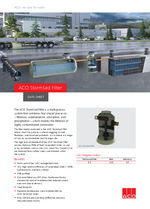
Initial discussions in late 2022 and early 2023 could not establish an optimal solution for the treatment of the surface run-off. However, with the launch of ACO’s StormSed range during the design phase, the project team reassessed the proposed system. The StormSed Filter 1800 and StormSed Vortex 1000 units offered superior pollution capture at a lower overall cost, making them the best solution for the sensitive location.
Through 2023 and 2024, ACO worked closely with Neath Port Talbot County Borough Council using ACO’s expertise built on decades of research, innovation and in-the-field experience to refine and optimise the drainage layout. The final scheme – approved in March 2025 by both the SABS office and NRW (Natural Resources Wales)– divided the carriageway into several drainage networks to improve control and resilience.
The central reservation now includes 70m³ of attenuation supported by StormSed treatment chambers, Q-Brake flow controls and ACO HB480E+ kerb drainage to efficiently collect run-off. The additional networks utilise further StormSed chambers and Q-Brake units, with attenuation delivered via the existing pipe system and supplementary concrete chambers positioned as catch pits.
Nick Tucker, Key Designer at Neath Port Talbot County Borough Council, said:
“The A483 plays a vital role in regional transport, so tackling the recurring flooding was essential. ACO’s expertise and their team’s willingness to work closely with us and NRW allowed the project to progress smoothly, despite the environmental sensitivities. The final design gives us long-term confidence in both road safety and the protection of the surrounding wetlands.”
A long-term solution for Fabian Way
The completed design not only resolves the longstanding flooding challenges on the dual carriageway but ensures that the wetland ecosystem surrounding the River Neath is protected.
By adapting its stormwater treatment solutions to the unique circumstances and maintaining close collaboration with both the Neath Port Talbot Council and the NRW, ACO has delivered a drainage system that, with the correct maintenance, will mitigate flooding risks in the area for years to come.
Neath Port Talbot County Borough Council has committed funds towards ensuring that the attenuation system is routinely cleaned while the central reservation grass is cut, providing the maintenance required to give the system an extended life and ensure it works as intended.
The scheme stands as an example of how intuitive civil engineering can successfully meet both infrastructure demands and environmental obligations – strengthening the A483 for years to come.
For more on ACO’s drainage solutions, see www.aco.co.uk