

- Sector
- Transport infrastructure
- Project type
- New build
- Services provided
- Product / system manufacture
- Product / system supply
- Year completed
- 2025
- Client
- Transport for London (TfL)
- Products used
- KerbDrain SP480 units
Opened 2025, Silvertown Tunnel – a new tunnel highway under the River Thames – will be open to the public to help ease congestion in London. Designated as a Nationally Significant Infrastructure Project (NSIP), ACO Technologies was brought on board to design in protection for two critical, yet quite different, hazards that could occur in the tunnel. The result was a combined kerb and drainage solution, a custom-made expansion joint, and bespoke-engineered flame traps that stretch all along the new underground highway.
In May 2018, Transport for London (TfL) was granted permission on its plans to build a new twin bore, 1.4km tunnel underneath the River Thames to link Silvertown to the Greenwich Peninsula. Opened in 2025, the Silvertown Tunnel will aim to ease traffic and reduce journey times by up to 20 minutes in Central London.
However, while the new highway does not have to contend with the same storm and rainwater management issues that surface level roads do, there are two significant hazards that need safeguarding against. Namely, flooding inside the tunnel in the event that sprinklers are set off from a vehicle fire, and the potential for a vehicle fire to spread along the tunnel’s drainage system.
To mitigate against these issues, ACO Technologies (ACO) was brought on board at an early stage by principal engineering consultancy COWI, part of the Riverlinx construction joint venture. Pulling together both its Water Management and Building Drainage divisions, ACO designed a bespoke combined kerb and drainage solution, with a unique pipework connection to the wider drainage network that would also function as a flame trap.
Managing vehicle fires and flooding
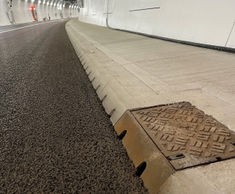
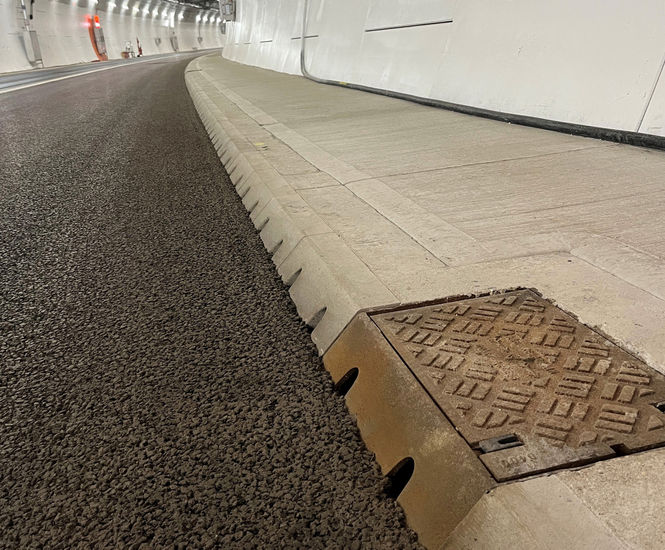
The first stage of ACO’s design process was to undergo a hydraulic assessment and calculation. Using its QuAD software to model the flow rate, taking into account the gradient and geometry of the tunnel, ACO determined that it would need to use its bespoke splayed KerbDrain SP480 units to take the expected flow of water were the sprinklers to be activated. Forming 2.8km of combined kerb drainage along one side of each tunnel, a total of 5,600 units of ACO’s KerbDrain SP480 were installed on the project, with KerbDrain Gully outlets every 15m.
A crucial element to the scheme was making sure that the combined kerb drainage solution also conformed to TfL’s own highways specification requirements and had inlets no more than 50mm in diameter. ACO’s KerbDrain solution met these criteria, allowing water to drain from the highway surface but preventing any large debris or litter from falling in and potentially blocking the channels.
Not fuelling the fire
As well as being able to take water off the highway, another key design element of ACO’s KerbDrain solution was a bespoke flame trap system.
To mitigate against the risk of flame passage through the drainage network in the event of a fuel spillage and fire, ACO designed the pipe connection between the KerbDrain Gullies and the carrier pipe with a u-bend so that there would be standing water in the connecting pipes. The clever arrangement means that while water from the sprinkler system will drain away if activated, fire would not spread into the downstream pipe network.
The flame trap section is made from stainless-steel pipes and connectors fabricated by ACO Building Drainage. In addition to this unique design, ACO had to overcome a sizing issue when connecting to the ductile iron pipes of the underground drainage system that take water away to connecting sewers. With the ductile iron pipes being 170mm in diameter and ACO’s stainless-steel pipes being 160mm, ACO engineered a custom spigot to allow both pipe systems to connect.
Accounting for expansion
In April 2024, with the project already underway and the majority of ACO’s KerbDrain units installed, it became apparent that expansion joints at the interface of tunnel sections would be needed. These were required to allow for anticipated movement and settlement of the segments, whilst allowing continuous drainage through the joints. With this being a critical issue, ACO was called in to help design a bespoke accessory that would connect the runs of KerbDrain SP480 units together and allow for this possibility.
As well as needing a bespoke solution, this accessory was required in just two months, from the point of enquiry to its eventual delivery to site in June 2024, owing to the project being live and needing to progress for other trades to start their work on the tunnel.
ACO’s research and development team immediately set to work to develop a channel expansion joint. It had to allow for a horizontal movement of up to 20mm, and a vertical movement of up to 16mm, and be able to withstand the force of a ten-tonne lorry mounting the unit.
The resulting solution was a stainless-steel unit, anchored to the road surface either side of the KerbDrain SP480 units. The unit was designed with an internal and external rib structure to provide strength. The expansion joint solution was tested to EN1433 standards. Two tests were conducted, the first being a 10-tonne accidental wheel loading specification test which is set out in the design manual for roads and bridges (DMRB). The second test was done in accordance to EN1433 Load class D400. Behind the stainless-steel cover, ACO specified two flexible 100mm polypropylene pipes that would carry water across the joint, in the event of the sprinklers being activated.
Following rapid prototypes being made and delivered to site for installation testing, a total of 19 bespoke channel expansion joints were manufactured at ACO’s Bedford site and delivered for installation in good time.
Tunnel vision for safety
Commenting on the whole project, Mathais Hansen, Senior Engineer at COWI, said:
“When we were awarded this project, we knew straight away that we would need the specialist experience and knowledge that only ACO would be able to offer. We already knew of ACO’s experience on these types of highways project, having seen that they had worked on projects like Hindhead Tunnel in Surrey, and their reputation for tunnel projects in Germany. “Overall, we were very impressed with the whole process. As we know, vehicle fires in tunnels are highly dangerous.
Road users can become trapped in the tunnel while fire services may find it difficult to reach the incident if the tunnel is congested with a few instances in history proving just how volatile these situations can be. Sprinklers can help contain fires, but then it introduces new dangers like flooding. This is why it is imperative that the risks are properly managed. ACO came up with a solution to alleviate the dangers of flooding and fire spread, while ensuring the products chosen met with specifications we had to work to.”
Mikel Goirigolzarri Martinez, Project Manager for Riverlinx, said:
“Having ACO on this project has really shown why they are leaders in the field of drainage and water management. Not only did they provide a first-class design service, their KerbDrain SP480 combined kerb and drainage solution was also very easy to install.
“The speed at which ACO was able to turn around the design, testing, production, and delivery of the channel expansion joints was highly impressive too, and it’s meant we were able to keep the project moving and keep on track with timescales. We were incredibly grateful to the team for providing some training guidance on how to install the products too, and going above and beyond to ensure the job went smoothly.”
Terry Wilkinson, Specialist Design & Application Engineer at ACO, said: “It isn’t every day that you get to work on a project with such significance as Silvertown Tunnel and we’re proud to have our solutions specified on the project. By combining all of our experience across our divisions and working meticulously with Riverlinx, we’ve come up with a drainage system that satisfied all the necessary requirements from TfL and make the tunnel safer for users and the tunnel infrastructure itself.”
For more about ACO, please visit www.aco.co.uk