- Project type
- Refurbishment
- Services provided
- Product / system manufacture
- Product / system supply
- Installation
- Year completed
- 2025
- Project location
- Scotland
- Contractor
- 4DStructures
- Products used
- SDS GEOlight®
- SDS Aqua-Swirl
- SDS Weholite Manholes
- SDS Weholite flow control chambers
Background
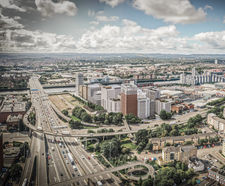
Central Quay occupies a 4.4-acre site in Glasgow's Anderston district, next to the River Clyde. The site was formerly home to the Harland & Wolff Finnieston Diesel Engine Works and had remained derelict for over half a century before the current redevelopment began.
The scheme involves the modernisation of an existing 80,000 sq ft office building alongside the construction of new residential, student and commercial buildings. The approved development provides 409 residential apartments and 934 student beds across four buildings, along with 11 commercial units, new public spaces, roof gardens and a central plaza.
The regeneration project is expected to contribute £7.7 million of annual spending to the local economy and generate 650 construction jobs per year throughout the build programme.
Project objectives
The central objective was to implement a surface water management system capable of supporting the delivery of a sustainable mixed-use riverside development. This required mitigating flood risk, protecting surrounding infrastructure, ensuring compliance with environmental regulations and contributing to the ongoing regeneration of the River Clyde corridor.
Drainage challenges
The scale of the Central Quay development, combined with its dense city-centre location and proximity to the River Clyde, presented significant surface water management challenges. Large areas of impermeable roofs, pavements and access roads meant that heavy rainfall could generate high volumes of runoff in a short period of time.
Without an appropriate drainage strategy, this would have increased flood risk on-site and placed additional pressure on downstream drainage infrastructure. The system also needed to deliver reliable pollutant removal (including suspended solids and hydrocarbons from vehicles and hard surfaces) while providing sufficient attenuation to control peak flows into the river.
To align with sustainable urban drainage principles, the solution had to be compact, low-maintenance and compatible with the constraints of a high-density brownfield redevelopment.
SDS solution
Aqua-Swirl® Hydrodynamic Separators
SDS supplied two Aqua-Swirl® units, an AS-2 and an AS-3, each serving a separate drainage catchment within the development. These catchments include roofs, access roads and hard-landscaped areas where runoff carries sediment, oils and hydrocarbons from vehicles and surface wear.
The larger unit was selected to manage higher flows from the main hard-surfaced areas. The smaller unit provides treatment for secondary areas with lower flow volumes but still notable pollutant loads. By deploying two units sized to their respective catchments, the system ensures treatment performance is maintained across varying flow conditions.
GEOlight® Attenuation Tank
The GEOlight® attenuation system provides 283m³ of underground storage, regulating stormwater discharge to the River Clyde at controlled rates agreed with Scottish Water. The system was installed with prefabricated Weholite manholes and flow control chambers, facilitating straightforward inspection, low ongoing maintenance and long-term operational resilience.
Approach and installation
SDS worked closely with the project team and drainage engineers, including principal contractor 4DStructures to ensure the system was correctly sized, positioned and installed without affecting construction timelines.
By combining treatment and attenuation in a single integrated system, SDS addressed both pollution control and flood management within a compact footprint, reducing the burden on downstream drainage infrastructure.
Outcomes
The installed system ensures that surface water discharged from Central Quay is treated to a high standard and released in a controlled manner, protecting the River Clyde from pollution and excessive runoff. The attenuation capacity also provides flood resilience for the development itself, safeguarding new buildings, basement levels, pedestrian walkways and car parking areas.
Alongside energy-efficient buildings, green roofs, EV charging infrastructure and new habitat planting, the SDS systems form part of a broader sustainability framework for the site. The integrated drainage solution supports Glasgow's environmental objectives and contributes to the long-term resilience of the development as a model for sustainable mixed-use regeneration on brownfield land.
In their words
“SDS provided a surface water management solution that supported the Unite Central Quay project. Communication with the project team was clear and well-coordinated, ensuring work could progress smoothly in a busy city centre location. The system was designed to fit neatly into the available space, avoiding complications with the wider construction.”
Paul McMenamin, Contracts Manager, 4DStructures