

- Sector
- Sport
- Project type
- New build
- Services provided
- Design
- Product / system manufacture
- Product / system supply
- Installation
- Year completed
- 2026
- Project location
- South East England
- Client
- Winchester Racquets and Fitness
Winchester Racquets and Fitness is one of the premier sports clubs in the South of England. With a long-standing reputation in tennis and squash, the club has continued to evolve, adding comprehensive fitness facilities and establishing itself as the leading destination in Hampshire for tennis, padel, squash, and fitness.
The club's facilities include four indoor courts, five artificial grass courts, four artificial clay courts, two macadam courts, and three padel courts. The padel courts sit at the heart of the club's modern offering.
The challenge: padel's unique noise problem
Independent research and acoustic assessments have confirmed that padel produces sharper and more intrusive peak noise levels than traditional tennis, largely due to the use of solid rackets, the frequency of ball impacts against glass back walls, and the partially enclosed design of padel courts, which can reflect and amplify sound.
The noise generated is not from a single source but from several factors acting in combination. Ball impacts against glass panels create a distinctive cracking sound, while strikes on wire mesh fencing generate metallic, high-frequency noise. The solid racket produces a harder, more percussive sound than a strung tennis racket, and because padel is a social, doubles-based sport, there is typically more vocal noise during play.
Winchester Racquets and Fitness is situated in a residential area, making it essential to find a robust and effective solution that would protect neighbouring properties while allowing padel to continue to thrive at the club.
The solution: bespoke Jakoustic® acoustic barriers
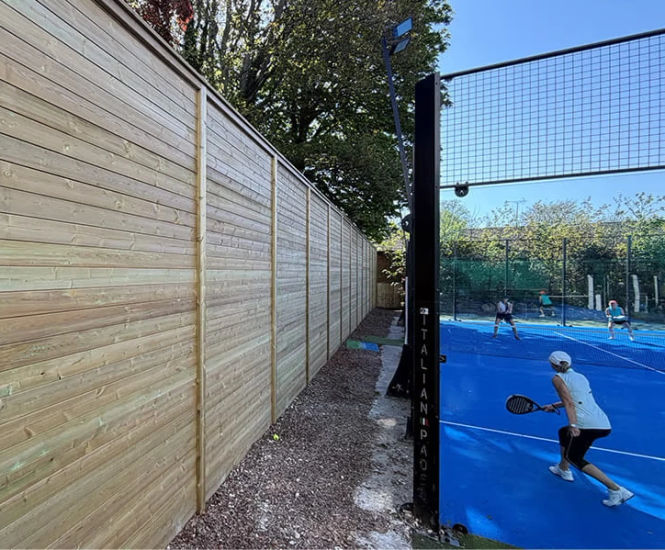
To manage padel noise and ensure long-term compatibility with the surrounding residential environment, a bespoke acoustic barrier solution was designed and installed around the padel courts. Jacksons Security supplied and installed approximately 33 metres of 4-metre-high Jakoustic® Reflective acoustic barriers, along with an additional 5 metres of 3.3-metre-high acoustic barriers.
Given the height required for effective noise control, the project used the Jakoustic® Commercial and Highway variant a system specifically designed for taller applications. It is constructed on galvanised steel I-beam posts to provide the necessary structural strength and stability. The steel I-beams are fitted with timber nailing battens bolted to the front of the posts, allowing the acoustic fence panels to be securely fixed while maintaining acoustic performance and providing an attractive timber face.
The installation also included one matching single-leaf swing gate, measuring 2 metres high by 1 metre wide, with all steel components fully galvanised for durability and corrosion resistance in an outdoor sports environment.
How the barriers work
The Jakoustic® Reflective acoustic barriers are engineered to deliver up to 28 dB of noise reduction, achieved by reflecting sound away from sensitive receptors rather than allowing it to pass through. The barrier design is based on heavy-section, planed timber V-shaped boards that interlock tightly, minimising gaps through which sound could otherwise escape.
By eliminating gaps and air pathways, the barriers significantly reduce the transmission of the sharp impact noises generated by padel play. With sections reaching up to 4 metres high, the installation is well aligned with the heights commonly recommended in padel noise assessments.
Additional Benefits
Beyond noise reduction, the installation delivered several further advantages. The timber acoustic barriers provide a natural, unobtrusive appearance that complements the setting of a premium sports club, while also delivering durability, security, and long-term value through a 25-year guarantee.
The barriers also provide a security benefit, with a profile that is free from hand and footholds and difficult to climb. They provide privacy for both players and residents on the other side of the fence.
Outcome
The installation at Winchester Racquets and Fitness demonstrates how high-performance acoustic barriers can successfully mitigate noise while maintaining the quality, usability, and appeal of sports facilities. By protecting the amenity of local residents and supporting uninterrupted play, the project shows how well-designed acoustic barriers can turn padel courts into a welcomed community asset, enabling the sustainable growth of the sport while safeguarding local quality of life.