

- Sector
- Public realm
- Project type
- New build
- Services provided
- Site survey
- Design
- Project management
- Installation
- Year completed
- 2026
- Project location
- London
Project overview
Meristem Design worked on the revitalisation of St John Street, a new public realm scheme in Clerkenwell. Alongside Islington Council, Central District Alliance, Cross River Partnership and local community group, Clerkenwell Pollinator Path, we helped transform a previously congested, grey area into a greener, healthier and more welcoming space. The project responds to community feedback in which residents and stakeholders called for increased biodiversity, an improved public space and safer streets for walking and active travel.
We helped bring surface water management and biodiversity to the space through a range of installations and Urban Greening Add-ons and Extras. Our work focused on boosting the pollinator population and involving the community in the process.
Goal
The project aimed to support the wider transformation of St John Street into a greener and more accessible space in Clerkenwell. A key objective was to increase biodiversity along the street through planting and habitat creation, helping to bring ecological value to a dense city centre location. Another priority was to introduce sustainable drainage that contributes to better water management and climate resilience. The project also aimed to create a more interesting and engaging way to move through the space for the surrounding community.
Scope
The project area sits in the heart of Clerkenwell, close to Farringdon and Barbican stations as well as local community groups and a primary school.
As part of our Urban Greening Add-ons and Extras, we focused on multiple points along the street to integrate greenery into the wider public realm:
Planting over 1,500 plants
4 large roadside planting beds / rain gardens
2 smaller supporting rain gardens
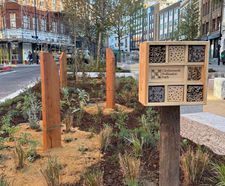
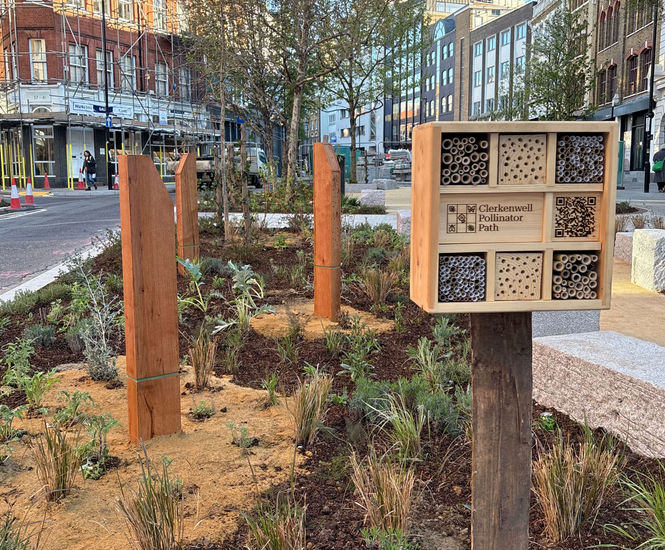
3 bee posts
12 ivy posts
1 community-designed bug hotel
Solutions
Our approach combined a biodiversity-led planting design and habitat creation with community involvement to bring the space to life. The project was designed to increase ecological value, support pollination and uplift the space.
Construction of Green Pathways
We designed a diverse planting plan that features a range of pollinator-friendly shrubs and perennials to encourage active pollination and support the new pathways that have been installed.
Bee Posts and Bug Hotels
We fabricated and installed 3 bee posts to attract and provide nesting spaces for bees. The community group, Clerkenwell Pollinator Path, designed a bug hotel to create habitats for insects.
Ivy Posts
We installed 12 ivy posts throughout the space as they help encourage late-season pollination and are a vital source of nectar and pollen.
Nature Workshop and Community Planting Day
We ran a nature workshop with children from a local primary school and a community planting day with residents and stakeholders to teach practical planting skills and bring people together.
Impact
The public realm improvements have delivered a range of environmental and community benefits, while supporting the creation of a new green corridor through the space. A key focus has been the enhancement of rainwater management, alongside a number of other positive outcomes.
Biodiversity Boost
The addition of shrubs, grasses and perennials create a diverse green space that attracts bees, insects and other wildlife.
A More Welcoming Public Realm
The creation of pathways, seating stones and enhanced greenery makes the place more attractive and inviting to spend time in and pass through.
Supporting Active Travel
The project was installed alongside the council's one-way conversion of the road, supporting a lower traffic environment and greener, alternative modes of transport.
Community Involvement
The consistent engagement with local residents and stakeholders throughout has created a space that was shaped and even planted by the community which uplifts the area's sense of character and pride.