

- Sector
- Transport infrastructure
- Services provided
- Site survey
- Planning advice
- Design
- Product / system manufacture
- Product / system supply
- Installation
- Project location
- Wales
- Consultant
- Architect: Holder Mathias
Challenge
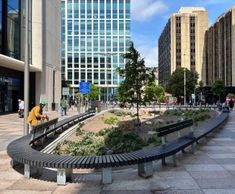
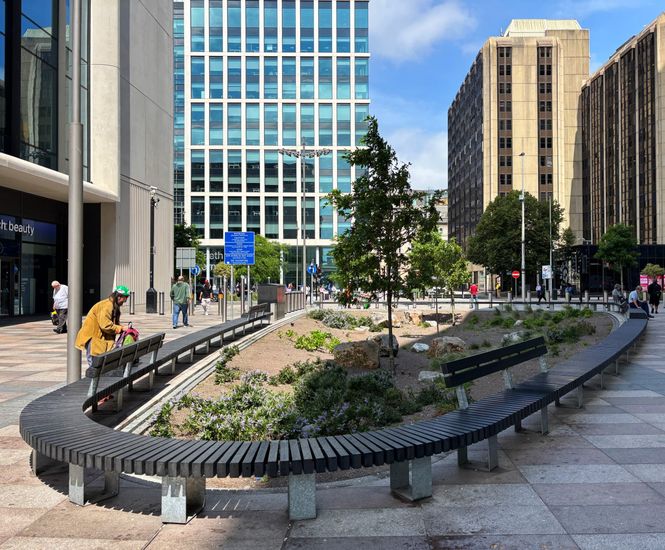
Benchmark was commissioned to manufacture two expansive, sculptural benches, each ranging between 70 and 90m in length, for Cardiff Bus Interchange. The seating needed to handle high footfall, varied weather and rigorous long-term use, all while complementing the architectural flow of the surrounding development.
Located in one of the busiest pedestrian zones in Wales, the Cardiff Bus Interchange project presented a unique challenge in urban street furniture design and fabrication. Positioned at the crossroads of Cardiff Central Railway Station, the new bus terminal and the BBC Wales HQ, the public space demanded both visual impact and durable functionality.
Solution
The standout feature of the project was the complexity of the curved layout. Each bench followed a unique radius, seamlessly sweeping around a central landscaped area. The form demanded pinpoint accuracy in fabrication as well as simplicity for the installation team.
Working closely with the architects Holder Mathias, Benchmark ensured every section was manufactured with tight tolerances to enable precise bolted connections and create the illusion of a continuous form.
To ensure the benches could endure years of public use and environmental exposure, the seating has a galvanised steel frame, offering excellent structural integrity and corrosion resistance.
The slats were produced in a recycled plastic helping to keep the overall carbon footprint down. The high-performance recycled plastic slats offer great durability and longevity as well as a consistent finish. These slats, although finished in a black, easily replicate the aesthetic of timber but also provide superior resistance to rot, splintering and vandalism.
The benches were fabricated in modular sections, which bolted together seamlessly to form uninterrupted curves.
Strategically positioned backrests were added for comfort and to enhance the visual rhythm of the seating. These elements were placed at intervals to maintain openness while providing rest points. Armrest were also added at certain points.
All materials were chosen for their minimal upkeep requirements, ideal for a high-traffic urban zone.
Outcome
These two monumental benches now act as focal points in the newly developed interchange space. Not only do they offer practical seating for thousands of daily commuters, but they also enhance the environment through thoughtful design and robust, sustainable construction. The installation highlights how well-engineered street furniture can contribute to placemaking in high-profile public realms.