



- Sector
- Transport infrastructure
- Project type
- Refurbishment
- Year completed
- 2024
- Products used
- Modular Drainage System
Civil Water Management is proud to be part of a pioneering project aimed at improving flood resilience on the Sustrans National Cycle Network—a crucial step toward building a more accessible, low-impact active travel infrastructure across the UK.
The Challenge: Persistent Flooding and Poor Access
Flooding has long been a challenge for the National Cycle Network, particularly in the winter months. It poses serious accessibility issues, especially for disabled users and young families, and discourages regular use of the network.
One such site is a section of Route 6 between Milton Keynes and Castlethorpe, a key green corridor connecting communities and linking with Wolverton Station. Repeated flooding had left the path in poor condition—narrow, muddy, and often impassable. As Nigel Brigham, Sustrans Engineer, recalls:
“The path was in a dreadful state. After heavy rains, water was standing for a long time. A tough mountain biker might get through, but most people were put off using it. The local community were keen to find a solution.”
The Solution: Integrated Modular Drainage
It was quickly realised that Civil Water Management's modular drainage system technology - made from resin encapsulated recycled tyre rubber—offered a promising alternative.
The system is porous, lightweight, and sustainable, allowing water to drain both quickly and naturally off the path without the need for large trench excavations, pipe and loose granular stone.
Together with Milton Keynes City Council, the team secured funding through the Department for Transport and Connected Places Catapult Rural Transport Accelerator programme for a 200-metre stretch of Route 6.
Despite complex and constrained conditions—proximity to the West Coast Main Line, and local badger habitats—the project was designed and delivered successfully utilising a first of a kind no-dig build method.
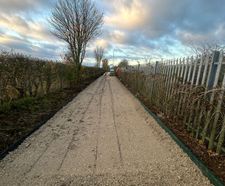
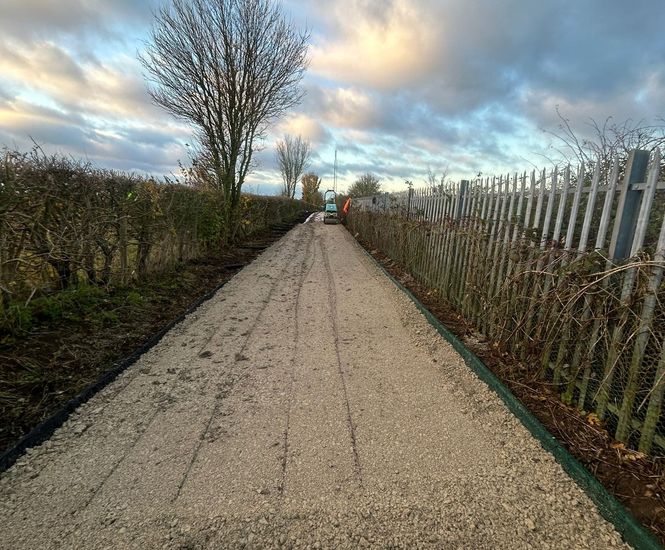
The path was widened to three metres and resurfaced using modular drainage unit edges, spurs and drainage mats to create an integrated sustainable drainage system. The surrounding verge was seeded with meadow grass, further enhancing biodiversity.
Crucially, the sustainable drainage plan unlocked by the modular drainage system solution received approval for the whole ~2.5km route, enabling a further ~1km extension of the solution to be successfully installed in June 2025 – while paving the way for the design and build of further extensions in the future.
The Outcome: No Flooding, Carbon and Cost Reductions, High Social Value Impact
Performance through winter 2024 was highly encouraging: the treated section remained entirely flood-free. Continuous site monitoring—including live camera feeds—supports this evidence.
Carbon and cost benefit analysis vs. conventional materials and methods that would traditionally have been considered to try and provide drainage, using excavated trenches, pipe and gravel, showed estimated: carbon reduction of up to 50% and cost savings of 19%.
Carl Hopkins, Managing Director of Civil Water Management, said:
“The response from the local community has been incredibly positive. Providing safer, flood-free paths that connect people to public transport makes travel greener, more accessible, and more enjoyable for everyone.”