

- Sector
- Utilities
- Project type
- New build
- Services provided
- Product / system supply
- Year completed
- 2024
- Project location
- London
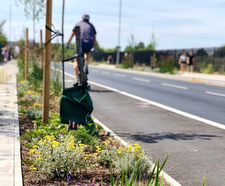
Wavin worked in partnership with Meristem Design to create a smart rain garden in a Central London borough which allowed for both increased plant life and irrigation.
Working with Netafim, they were able to use smart technology to monitor moisture levels in the soil and recycle captured and stored rainwater to water plants in times of drought.
Challenge
Following consultation with the local community, a London borough sought to refurbish a 0.5km stretch of road, bringing greenery to the entirety of one side of the carriageway. This would be delivered with the use of rain gardens totalling nearly 400m in length.
While this proposal would deliver excellent results with respect to SuDS guidance, one concern was the cost of maintaining such a large system, especially in a dry and warming London. The borough had installed similar, smaller rain gardens previously to great success.
A common pain with earlier installations, and a growing concern for this new site, was the cost of watering the proposed green infrastructure during extended dry periods.
Solution
Following site visits and conversation between all stakeholders, a ‘smart rain garden’ solution was developed.
Pairing Wavin’s water management expertise with Meristem Design’s rain garden installation, the client now has an underground rainwater storage tank capable of storing approximately 5 weeks’ worth of irrigation for use during dry periods.
Using sub-surface moisture sensors and irrigation lines, the solution only draws on the retained rainwater when it is needed.
The storage system is filled using treated surface water runoff that infiltrates through the rain garden into a perforated pipe.
Why AquaCell?
One concern for customers with shallow SuDS systems such as rain gardens is their need for regular maintenance.
By using infiltrated and retained rainwater, paired with a smart irrigation system, installations such as the one in London can draw on the value of free rainwater that falls on the site instead of paying for it.
The result is a reduced OPEX cost which outweighs the initial CAPEX investment in the space of a few years. Furthermore, grey elements complement the green, ensuring they remain as designed.
In wetter periods, the ‘smart’ system includes an active drain down function. In turn, this will relieve pressure on the local surface water sewer and provide partial storage capacity with the rain gardens, to mitigate against low volume flood events. This is achieved by integrating predictive algorithms linked to weather data.