

- Sector
- Public realm
- Project type
- Refurbishment
- Services provided
- Product / system supply
- Installation
- Year completed
- 2023
- Project location
- London
- Client
- From Thames To Eternity project
- Contractor
- FM Conway
Context
CED Stone Group supplied 58 large blocks of stone as part of From Thames To Eternity, a temporary stone reuse project conceived by Matthew Barnett Howland and Oliver Wilton from University College London, and CSK Architects.
The project aims to stimulate discussion about material lifespan and reuse as the city endeavours to achieve its goals for a sustainable, net-zero city by 2040. As an art installation, it encourages Londoners and visitors alike to slow down, take a break, and enjoy London's public spaces whilst celebrating the role of stone in the development of one of the world's oldest cities.
Background
The stones weigh around 1 tonne each and have lived for the last 150 years as part of the Victoria Embankment river wall. In the early 19th century, untreated sewage and industrial effluent flowed directly into the Thames, causing disease and an unbearable smell exacerbated by the hot summer weather in 1858, dubbed 'The Great Stink'. Joseph Bazalgette, a civil engineer, put forward a proposal to fix the problem, by way of a sewer system. Parliament accepted the proposal, and by 1875, works were complete, with over 1,000 miles of sewers and many thousands of granite stones.
From the Thames to...
Due to the growth in population over the last century, these sewers are unable to cope, and so the construction of the new Thames Tideway Tunnel is underway, and this is where CED Stone's involvement began.
As part of the works, a few stretches of the river wall are being renewed, and CED Stone Group Chairman Michael Heap, was approached to discuss the matching and sourcing of new stone for the Super Sewer design. As part of that discussion Michael enquired what was to happen to the original blocks being removed. At that point there was no plan, and they were moved into storage in Dartford by the Tideway project team. Whilst in storage, CED Stone Group, amongst others, was tasked with finding a use for the blocks.
Asked to identify the individual granites that formed the stones, CED's resident geologist noted three different sources; a silver Cornish granite; a pink Scottish granite; and a few dark grey granite blocks from Wales.
The stones were stored in Dartford for a time, until the storage facility unfortunately closed. CED then arranged storage at a site in Tilbury, and it is here that the stones were selected for the City of London project.
Working the stone
Granite is an incredibly durable material, and as such, these stones could last for thousands of years and be used in countless future projects within the city. The architects decided not to cut the blocks down, which may have made re-use easier but would have reduced the potential for their use in the future, but the stones had to be cleaned and made safe.
The blocks destined for the streets of London were stored in CED's West Thurrock yard and prepped at its Bespoke Masonry Centre there. Richard, the stone mason, worked each block individually. Most were sandblasted on the rough top face, with the sandblasting gradually getting fainter when moving down the block until completely untouched. This shows the original masonry residue and history of the stone.
Richard also worked a few "map" blocks. These were the exception, laid the opposite way up to show the flat face that would have stuck out into the Thames. Only the sides of these blocks were sandblasted; the top surface remains in its original state, showing the tide marks caused by the Thames.
Where are they now
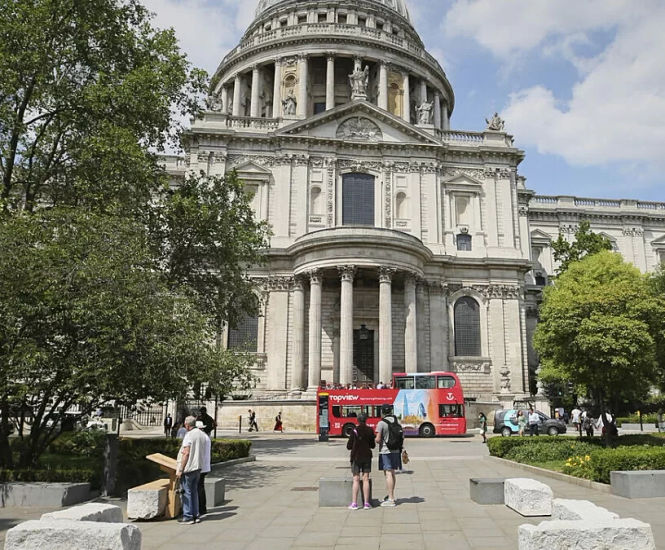
The stones can be found at seven sites across the city; Sermon Lane, Carter Lane Gardens, St Paul's Cathedral, Christ Church Greyfriars, King Edward Street, St Bartholomew's Hospital and Smithfield Rotunda Garden, with information boards at each location.
No foundations were required for the installation by contractor FM Conway; the stones simply rest on the ground, or are supported on reclaimed oak frames. This makes relocation easy, and the sites remain as they were before installation.