The unwanted water feature
Flooding in gardens and driveways
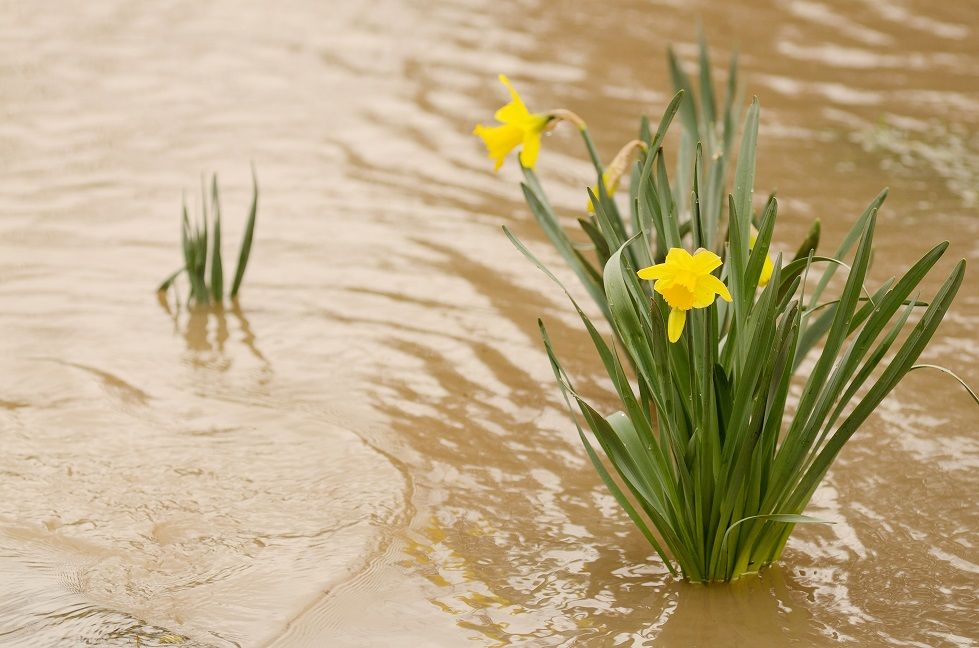
As a nation, we Brits spend no end of time and effort on our outdoor spaces. Looking into landscaping. Planting the right plants. Designing attractive driveways to cater for our cars. But the good old British weather can spoil all that effort in a moment. Rainwater – essential to the well-being of our gardens – can also ruin them if it can’t escape, leaving us with flooded flora and driveways drowned in brown standing water.
The solution is good rainwater management. This article covers a number of solutions; some remarkably simple, others more creative and involving. But all working towards the same end – beautiful outdoor spaces that rainwater can’t ruin, only enhance.
Seeking the source of the problem
Before we talk answers, however, we need to discuss the fundamental question; what’s causing the flooding?
The obvious first place to look is upwards. When you think that half an inch of rain falling on a modestly-sized 1000 square foot roof yields 300 gallons of water, you can see why it’s critical that runoff water from roofs is distributed evenly, and in a controlled manner. If the garden is on the receiving end of one downpipe, discharging into one area, the ground will become saturated and the water will take time to disperse.
Reaching a low point
Sometimes it’s a question of topography. Low level gardens can absorb water from their immediate surroundings – even from other gardens. There could also be problems with the local water table – the level at which ground water saturates the soil.
Soil types and soil composition can be factors too. Clay soil may be nutrient rich, but it drains poorly due to its density. Soil compaction can also play a part. Soil should have gaps that allow rainwater to flow through it, taking nutrients to plants. Over time, as our kids and our size 9 boots walk over it, the soil compresses, gaps disappear, and the water can’t flow through so easily.
At the end of the day, gardens and driveways flood because the water fails to leave an area as fast as it comes in. The greater the difference in speed between the water entering and the water exiting, the worse the flooding will be.
Paved-over front gardens can also be prime culprits. Non-permeable surfaces like paving, driveways and artificial grass obviously won’t absorb runoff. It has to go somewhere, and what can’t soak away soon becomes standing water.
Managing rainwater more efficiently
The way to approach water management is to think in terms of creating a complete system. Current thinking favours the creation of a sustainable drainage system – or SuDS.
A SuDS earns its name by preventing runoff water from overwhelming sewers, mixing with whatever’s down there, then finally being released into rivers as dirty water. The philosophy behind it is built on four key pillars; Quantity, Quality, Amenity and Biodiversity. Water Quantity is about controlling the amount of runoff to help manage flood risk, thus maintaining and protecting the natural water cycle. SuDS is also about managing the Quality of rainwater runoff, to prevent pollution. Amenity refers to using that water to create and sustain a better environment for people, while Biodiversity is about creating and sustaining better places for wildlife.
At ACO we’ve developed our own unique model that mirrors SuDS thinking – Collect, Clean, Hold and Release. Our model embraces the entire surface water management cycle, from the point where rain lands right through to where it re-enters the natural water environment.
Collecting and managing runoff
Preventing flooding by runoff water from roofs obviously comes down to installing suitable drainage. Well-designed drainage channels slow down run-off during periods of heavy rainfall, and direct it away from areas prone to flooding. Now, if you’re imagining a maze of unsightly drainage channels running around a property, let us put your mind at rest. There’s a wide range of channel drains available that won’t detract from your garden design – they can even enhance it, especially if you’re going for a contemporary look. If not, we have systems that are practically invisible, yet still super efficient.
Before choosing a channel drainage system, you need to ask two key questions: what traffic goes over it? How much water goes in it?
Different channelling has different load classifications. If it’s for a domestic driveway, for instance, a B 125 system should be the minimum classification, in order to accommodate the weight of cars. If heavier vehicles are likely to use the drive (think delivery vans or big 4x4s) then C 250 may be more appropriate. Once you’re clear on what will go over it, you then need to consider the quantities of water going into it.
Choosing the correct channel size is crucial to preventing flooding, so a basic knowledge of rainfall levels in specific locations – alongside various considerations over surface area and types – can help hugely. ACO’s free QuAD Hydraulic Design software can make this process much easier, with specific features to measure rainfall intensity by location.
Visit our QuAD software for more infomation
Cleaning, holding and releasing
With a channel system, keeping the water clean (by which we mean free of silt and dirt) is aided by fitting service points wherever channels change direction. This allows any build-up of materials to be cleared. But there are many other ways to ‘clean’ surface water runoff. These involve holding and managing it for maximum benefit, and releasing rainwater naturally back into the natural cycle.
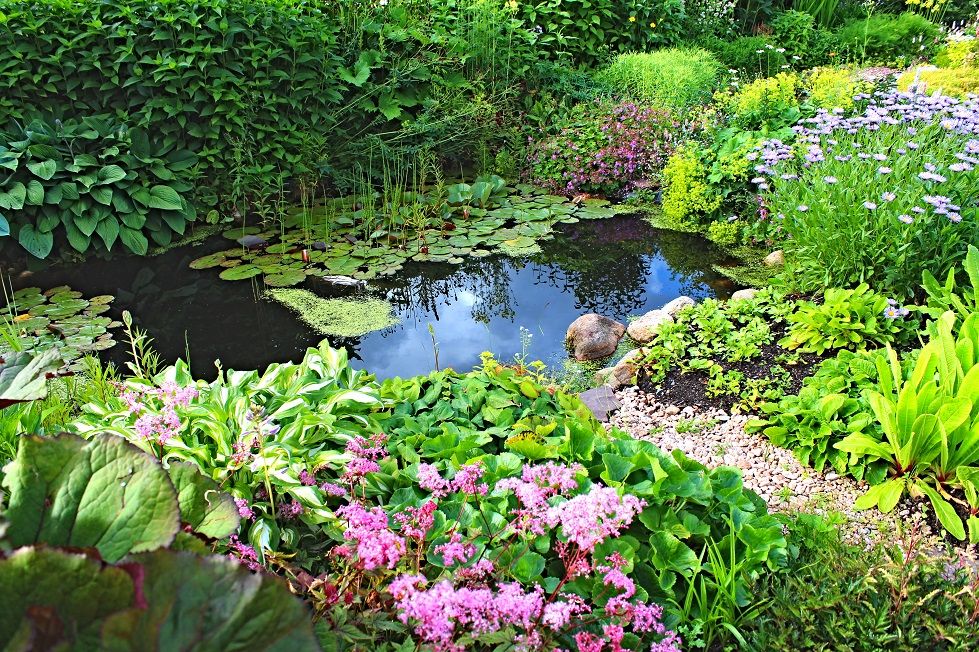
Perhaps the most attractive and creative way to do this is to encourage infiltration at surface level by planning and building a rain garden. This idea exploits a shallow area of ground or natural depression. This is then planted with species that can stand waterlogging for up to two days.
Rain gardens require a well-drained area 5m or more from a building*. Once you’ve dug a suitable area, you can use ACO channel drainage to get the water from the downpipe to the dip. A rain garden absorbs up to 30% more water than a lawn and can remove up to 80% of sediments from rainwater runoff. By slowing down heavy rainfall it’ll reduce soil erosion too. Best of all, a rain garden embraces all four SuDS principals, especially Biodiversity – flora and fauna thrive around them. You can find out more from these links
Infiltration can be encouraged below surface level too, by deploying a soakaway. This will help you direct large quantities of rainwater into the ground (where it benefits the soil) instead of as runoff (where it causes flooding). You can learn more about ACO domestic soakaway systems on the link below:
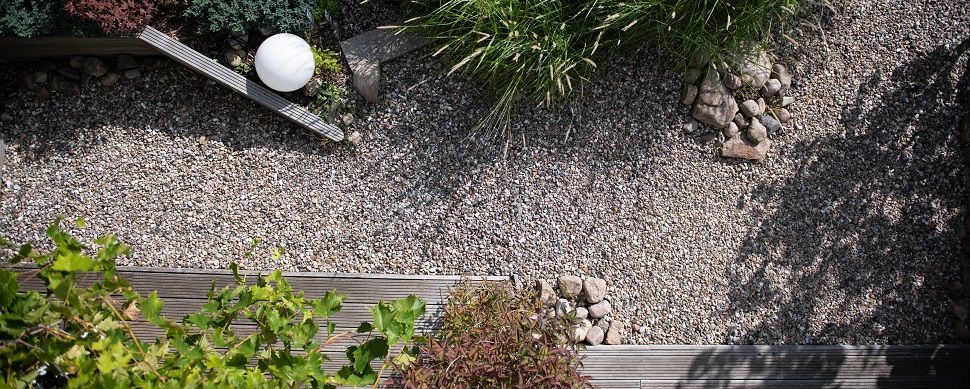
Of course, you might have to look for solutions where there’s no green outside space at all, and you’re forced to work with hard surfaces. In that case, consider gravel or grass instead of concrete or other non-permeable surfaces for paths and driveways. Gravel and grass allow rainfall to infiltrate back into the ground as a SuDS-friendly installation. And if you’re worried about these surfaces ‘drifting and rutting’, products like our ACO GravelGuard or GroundGuard tiles stabilise gravel and grass, making them ideal for driveways.