

- Sector
- Housing, private
- Project type
- New build
- Services provided
- Design
- Year completed
- 2022
- Project location
- South West England
- Client
- Balfour Beatty
- Products used
- ACO Wildlife Guide Walls and Climate Tunnels
Challenge
When tasked to construct a new 550m carriageway to connect a new housing estate to the wider road network, Balfour Beatty wanted to ensure its impact on biodiversity was minimised. The development saw the contractor landscape a 4.5-hectare open space, which included features to protect and improve the diversity of local wildlife.
One of the primary challenges for any highways project when looking to protect wildlife is ensuring safe passage for mammals and amphibians across busy roads. With the help of ACO Water Management, Balfour Beatty installed a number of innovative initiatives to help the local wildlife thrive.
Solution
Initially, ACO Water Management was introduced to support with the design, supply and installation of its KerbDrain system. However, it soon became apparent that its team could add further value thanks to the introduction of its wildlife protection products, as Terry Wilkinson, Specialist Design & Application Engineer at ACO, explains:
“We have a long-standing relationship with Balfour Beatty and at first we were tasked to supply our KerbDrain to remove standing water from the road network. We helped with the design and sizing of our award-winning system across the road. However, when we understood the wildlife mitigation requirements of the site we quickly realised we could add a lot more value to the project.
“We invited the team to learn more about our wildlife range, which included guide walls and access tunnels, and how the products can integrate together. These are specifically designed to protect wildlife, encouraging amphibians to safely make their way across the roads."
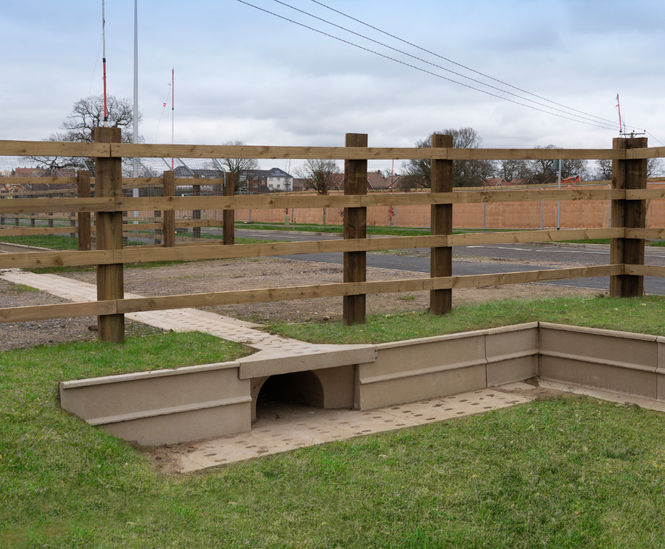
ACO’s Climate Tunnel can be installed flush with or below the road surface. For Ashridge Farm Road, both options were selected. The slotted ACO Climate Tunnel was installed at surface level, offering ambient conditions between the tunnel and open air thanks to the natural light and moisture levels achieved through the holes. A second Climate Tunnel was installed underneath the road, offering an additional safe passage for the animals.
The tunnels were complemented with ACO’s Guide Walls, which help prevent small animals from climbing into the danger area. One key feature of the ACO Guide Wall is that it suppresses vegetation growth, providing a clear pathway for small animals.
With Balfour Beatty introducing a range of biodiversity measures across the project, including ponds and grass verges, the introduction of both the Guide Walls and Climate Tunnels ensured further safety measures were in place to protect the local habitats.
Wildlife protection
One of the challenges when building wildlife tunnels – particularly when designing for amphibians – is avoiding traditional concrete due to its dry, caustic properties. When using this material, surface residue can build up, harming amphibians with potentially fatal consequences.
Alternative materials, such as polymer concrete, should be sought, as recognised in the Design Manual for Roads and Bridges (DMRB). Polymer concrete is also supported in various guidance, including the Somerset Highways Biodiversity Manual and Gloucestershire Highways Biodiversity Guidance.
All of the products in ACO’s Wildlife range are made from polymer concrete, offering added protection to the surrounding wildlife.