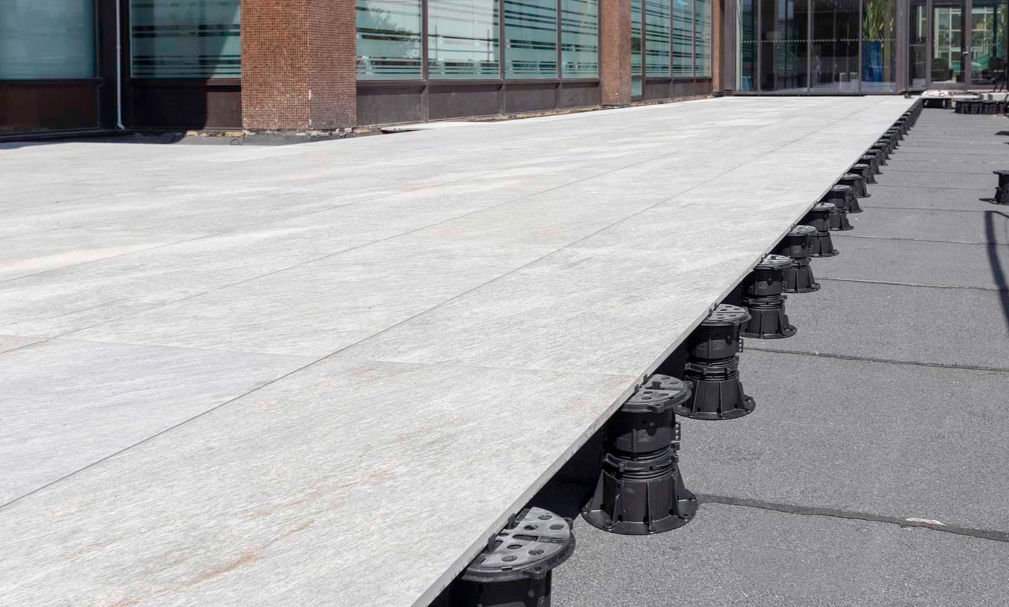
Each and every decking installation is going to be unique. With that will come unique challenges that need overcome to get the job done.
When it comes to specifying pedestal pavers, there are a handful of considerations to be made beforehand to ensure that the project isn’t put on hold or delayed.
In this blog we will discuss some of the common issues specifiers face in their decking installations and attempt to break the cycle of ‘by failing to prepare, you are preparing to fail’ mentalities.
Fire regulations - fire-rated pedestals and pavers
In the last few years there has been a huge call-to-action within the construction industry, regarding the need for improved fire safety on balconies. The Grenfell disaster is just one of the tragic events that shone a spotlight on the disastrous use of flammable materials in buildings.
Under new Building Regulations, the use of combustible materials in external walls and specified attachments such as balconies have been banned.
If a project is going to include balcony decking, then it is imperative that Class A fire-rated pedestals and pavers are the top consideration.
Trying to find the right products for these situations is time well spent and will save you a lot of time if you consider these things early. Pedestals such as the BC-FR range were designed with fire-safety in mind, and as such are suitable for any project requiring a B-fire rating.
For projects requiring maximum fire safety, there are products like the A-PED, which have been designed to provide a class A1 fire rating.
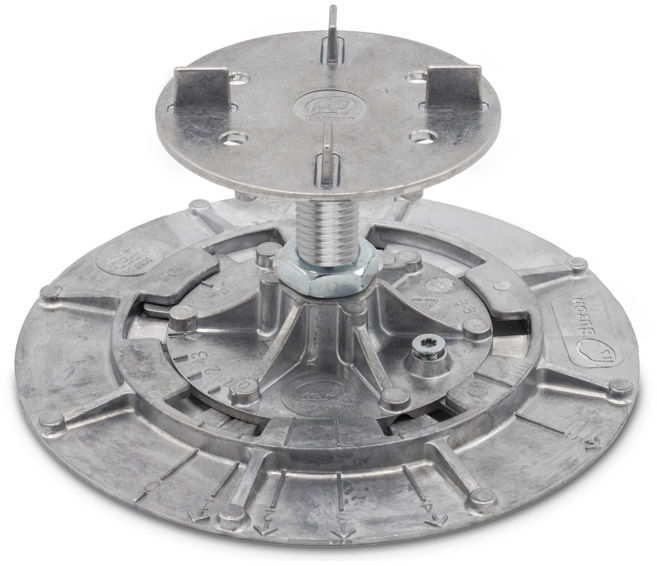
A-PED A1 fire-rated adjustable pedestal
Perimeters - do you need edging products for your pedestal pavers?
When specifying huge projects, it is easy to forget the smaller things until the last minute. A paving installation requires suitable gaps between your pavers and the perimeter.
Not only is it more aesthetically pleasing as a finish, but these gaps are fundamental in facilitating drainage and allowing rainwater to disperse on your paving. By preventing this type of pooling you can avoid damage to your flooring surfaces and also mitigate a health and safety risk.
Edging products and accessories such as the U-EDGE and U-WALL can help accomplish this and are compatible with most of our decking pedestals.
Stability and sound - pedestal pavers and shims
If you’ve installed paving before then you will know that trying to keep your pavers perfectly level can be a time-consuming process.
For when you are trying to adjust for natural inconsistencies or very minor height differences in pavers such as natural stone (and even 20mm porcelain) - shims will allow you to offset these and level out the paver quickly and effectively.
As a rubber ‘cushioning’ accessory that sits on your pedestal’s head, shims allow you to make small adjustments to the height of a paver to prevent trip hazards and create a uniform finish.
Shims also act as a natural cushion between the pavers and the pedestal head, which can deaden any excess sound, improving the acoustics of the pavers.
See Buzon's U-E10 and U-E20 BC range in action here
Location - considering wind uplift for pedestal pavers
Now we know that you’re thinking…Surely, weather conditions adverse enough to move your pavers are quite rare in the UK? You’re right. They are rare, but possible.
However, there may still be instances where paving will require stronger fixings than the natural downward force found in your pedestal pavers.
For example, tall buildings that are positioned relatively close to each other can run the risk of creating a wind vortex – despite this being a rare occurrence, it is still worth considering, as your location may indicate wind uplift as being a possible issue. It is always best to consult a qualified professional to calculate your risk in such a scenario.
In these instances, wind discs such as the U-WASHER have been specifically designed to give you extra security by physically locking down the pavers to the head of the pedestal.
For peace-of-mind in areas where wind uplift is not a significant issue, your pavers may simply benefit from a dab of adhesive on the corner of each paver. If doing so, ensure the glue you use is compatible with the material of the pedestal and pavers.
Conclusion
So, there you have four of the main considerations you should make when specifying pedestal pavers.
Whilst not all of these will apply to every one of your projects, it is important to bare this checklist in mind to avoid any unnecessary delays or last minute changes.
Choosing the correct pedestal for your project can seem daunting. That’s why we are on hand, with no worry of obligation. If you have any questions, just ask – advice costs nothing. If you need any more information on the subject, feel free to call us on 020 8614 0874.
Alternatively, you can let us know your query by clicking SEND AN ENQUIRY opposite and an expert will be in touch soon.