
Wasting water should be as socially unacceptable as blowing smoke in the face of a baby. That was the urgent appeal of Environment Agency Chief Executive Sir James Bevan in his famous “jaws of death” speech in 2019.
Despite that warning, England is still on a trajectory to start running out of treated mains water within 20 years. By 2050, the deficit is predicted to reach 3,500 million litres per day. And yet, we flush a third of our high-quality mains water down our toilets at home every day. That’s before we even consider that up to 60% of the drinking water supplied to commercial buildings, such as office blocks or hotels, is used where high-level treatment is simply not needed.
We are staring climate change in the face. The extremes of drought and heavy rainfall are already commonplace weather patterns. It’s an emergency that demands an imperative response: reduce personal water demand from the current 140 litres per day average. In 2019, Sir James Bevan said he believed a daily limit of 100 litres per person is possible by 2050; Denmark has already achieved 80 litres. If we reduced per capita consumption to 100 litres per day and leakage by 50%, and did nothing else, there would be enough water for an additional 20 million people. We can do it, he said.
Water UK has told the Government that a maximum 2050 target of 85 litres per person per day is feasible by 2050. But how? There’s no silver bullet. A mix of water efficiency policies and incentives are needed to meet even the more modest 110 litres per person by 2050 target set by the National Framework for Water Resources.
Current planning regulations for England and Wales require a 125 litres per person daily limit, but the Environment Secretary George Eustice has said he will encourage local authorities in the 14 most water-stressed Water Company regions to adopt an optional 110 litres per person daily. This lower limit is already applied through The London Plan, leading to much greater take-up of grey water schemes in new buildings in the capital.
Encouraging water to be reused in commercial, industrial and multi-occupancy residential buildings remains complex, requiring a mix of planning consents, cross-agency co-operation and favourable returns on investment.
Technology advances
Grey water technologies have moved on to help meet these challenges. Therefore, better understanding and evidence of what they can achieve is essential to drive informed policy decision- making, as well as adoption by architects, engineers, developers and planners.
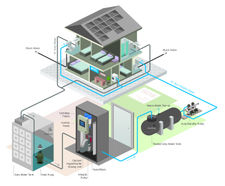
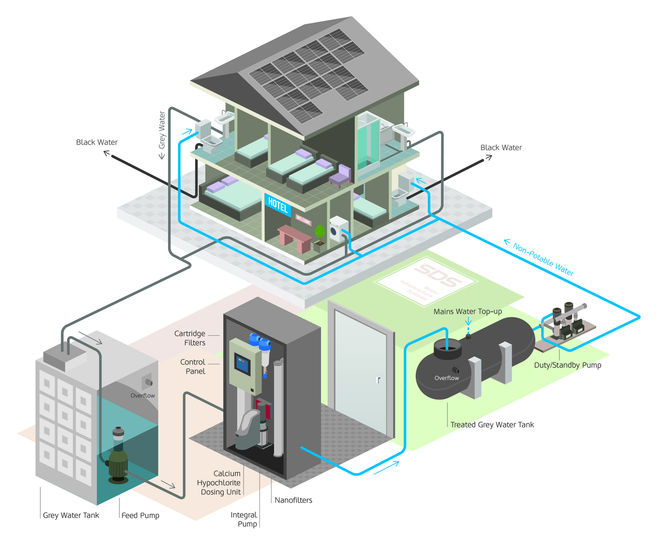
So what grey water exactly can be recycled? It is usually waste water harvested from baths, showers and handbasins, which is filtered, treated and then reused for non-drinking purposes such as toilet flushing, laundry or garden irrigation. Grey water systems are best suited for installation in new buildings because a separate network of additional pipework is required through the building.
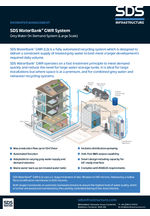
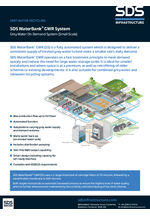
Any technology must first demonstrate it is commercially viable before its environmental benefits can be fully exploited. Advances in grey water technology using a new ‘on-demand’ process are providing a more responsive and cost-efficient process that makes the Return on Investment more favourable. The new technology offers early adopters of grey water systems the chance to replace legacy high-maintenance MBR systems with more efficient and cost-effective ones.
Download the PDF below for more info.