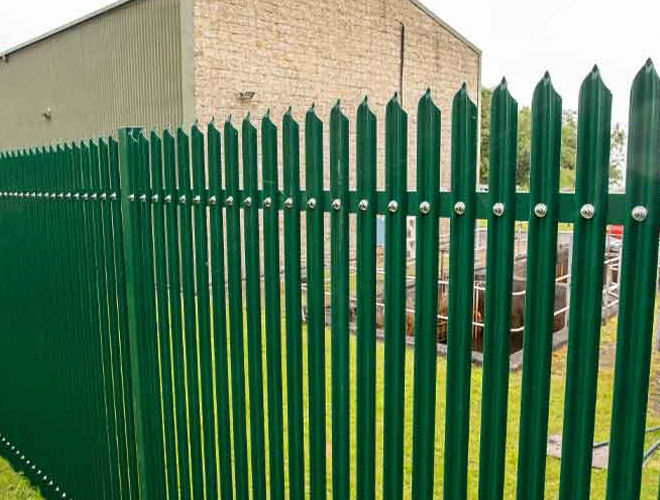
Stronguard palisade SR2 high security fencing
When discussing ‘security’ for data centres, it’s common for managers to focus a large portion of their time on mitigating online threats. However, it’s important that your data centre’s physical security is also taken into consideration.
In this post, we explore the security fencing options available to help protect the physical security of your data centre, so that you know exactly what measures to put in place to protect yours or your client’s vital assets.
Data centre perimeter fencing: minimum specification
However, if you are unsure on which high-security fence is best suited to your individual application, the team at Barker’s is more than happy to provide free, impartial advice.
As a minimum specification, we would recommend LPS1175 B3 (previously known as SR2) security fencing.
This solution would prevent intrusion for more than three minutes by an experienced attacker with tools of a higher mechanical advantage, such as bolt cutters, claw hammers and drills.
High-security tested fencing for your data centre
If there is a heightened risk of intrusion, perimeter fencing that offers a higher level of security is advised, and there are several solutions that provide additional testing to manage this heightened risk.
At Barkers, our main high-security systems are as follows:
Specifying a mesh or palisade system will be down to several key considerations, including:
Aesthetic requirements: Mesh is perceived as being ‘more friendly’ looking, as opposed to palisade which looks more intimidating so the right system for you depends on what you are trying to achieve.
Install time and ease: Palisade is often cheaper and quicker to install.
Ground conditions: Mesh doesn’t lend itself well to uneven ground.
Should I consider HVM fencing for my data centre?
Upon risk assessment, you may also decide that you want your perimeter to provide Hostile Vehicle Mitigation (HVM): HVM fencing is a single solution that is forced entry accredited and impact tested.
An HVM fencing means that you won’t need multiple solutions and that it can be installed in a single fence line, reducing installation time and costs.
Do you need a CPNI-approved fence?
CPNI stands for the Centre of Protection for National Infrastructure and is the body that approves security products for use on the UK’s Critical National Infrastructure.
CPNI approved fences have been designed for installation on sites of critical national importance in the UK. This level of accreditation offers a more substantial delay from attack through the use of hand and power tools.
So, if your data centre protects governmental property, we strongly recommend our CPNI approved StronGuard high-security fencing or if you would like a combined HVM and force entry fence we would recommend our StronGuardRCS.
Conclusion
As a minimum specification, we would recommend LPS1175 B3 (previously known as SR2) security fencing.
A key decision will lie in whether you specify a mesh or palisade system.
CPNI-approved fences may be required for data centres storing governmental property.