We have been helping designers and specifiers find the best solutions for their projects since 1988. EXTERNAL WORKS is an ESI.info brand.
Permeation grouting services
Permeation grouting, also known as cement grouting or pressure grouting, fills cracks or voids in soil and rock and permeates coarse, granular soils with flowable particulate grouts to create a cemented mass
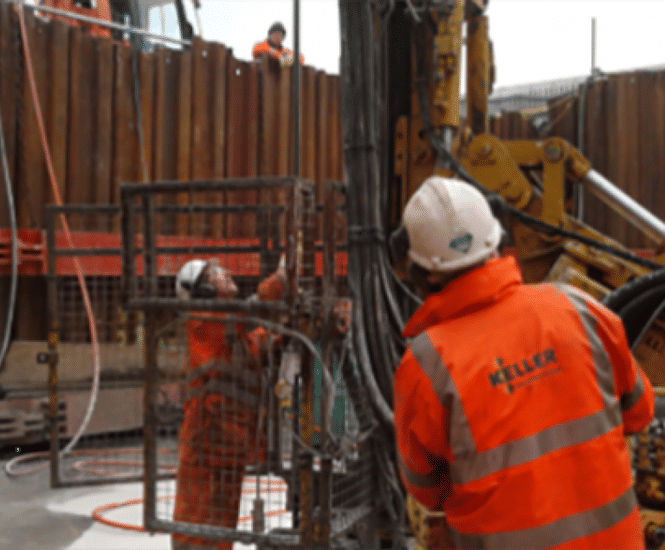
Click for full image
Permeation grouting for a services tunnel at New Cross
Service details
Permeation grouting, also known as cement grouting or pressure grouting, fills cracks or voids in soil and rock and permeates coarse, granular soils with flowable particulate grouts to create a cemented mass.
Typical applications
Create barriers to groundwater flow
Underpin foundations
Provide excavation support
Stabilise and strengthen granular soils
Process
Depending on the conditions, Portland cement or microfine cement grout is injected under pressure at strategic locations through single ‘port’ or multiple ‘port’ pipes. The grout particle size and void size must be matched properly to allow the cement grout to permeate. The grouted mass has an increased strength, stiffness, and reduced permeability.
Key benefits
An economic advantage for underpinning applications over alternative approaches such as removal and replacement or piling.
Allows you to maximise the footprint of excavations compared with piled solutions.
Can be done where access is difficult and space is limited.
Since effectiveness of permeation grouting is independent of structural connections, is readily adaptable to existing foundations.
Can typically be accomplished without disrupting normal facility operations.