We have been helping designers and specifiers find the best solutions for their projects since 1988. EXTERNAL WORKS is an ESI.info brand.
Compaction grouting services
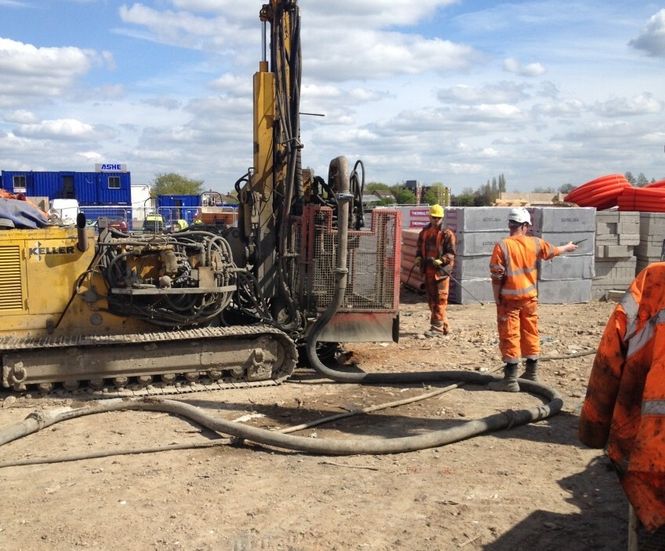
Compaction grouting involves the injection of a low slump, mortar grout to densify loose, granular soils and stabilise subsurface voids or sinkholes. It is suitable for rubble fills, poorly placed fills, loosened or collapsible soils, soluble rocks and liquefiable soils
Click for full image
Compaction grouting for ground stabilisation
Service details
Compaction grouting involves the injection of a low slump, mortar grout to densify loose, granular soils and stabilise subsurface voids or sinkholes.
Typical applications
Suitable for rubble fills, poorly placed fills, loosened or collapsible soils, soluble rocks and liquefiable soils
Often selected for treatment beneath existing structures because the columns do not require structural connection to the foundations
Decrease or correct settlement
Increase bearing capacity
Stabilise sinkholes or reduce sinkhole potential
Process
An injection pipe is inserted, typically to maximum treatment depth, and the grout then injected as the pipe is slowly removed in lifts, creating a column of overlapping grout bulbs. The expansion of the grout bulbs displaces surrounding soils and the grouting increases the density, friction angle, and stiffness of surrounding granular soils.
You can increase effectiveness by sequencing the compaction grouting from primary to secondary to tertiary locations. In all soils, the high modulus grout column reinforces the treatment zone.
Key benefits
Often more economic than conventional approaches such as removal and replacement, or piling
Can be done where access is difficult and in limited space