A discussion of the key issues to consider when designing and specifying tree planters
A. Maximum size
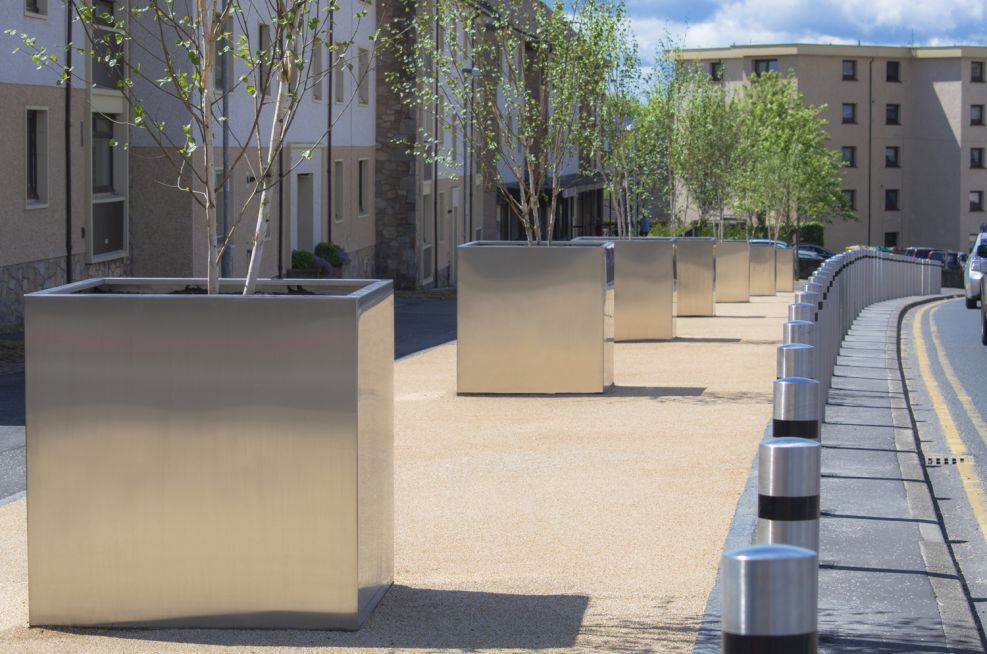
Tree planters can be made to any size, shape or design / arrangement. However, above a certain size, production economics and logistical constraints dictate that the planter must be sectioned.
This article covers simple, geometric, square, fully-fabricated (ie not sectioned) tree planters.
If the project allows it, the most cost-effective way to specify planters is to specify sizes that can be produced from a single sheet of metal and transported on a standard artic trailer.
This limits the maximum length x width profile to 2400mm (which is the maximum width of an artic trailer), and the maximum height to 1000mm (which is the maximum that can be fabricated from a single sheet of standard, ie cheap, stock sheet metal, where the other dimension is 2400mm).
To assist with discussion of value-for-money, weights and loadings etc, we will use a set of exemplar tree planters with dimensions as below:
L 1000 x W 1000 x H 1000mm (1m3 is really the smallest size for a tree planter)
L 1200 x W 1200 x H 1000mm
L 1400 x W 1400 x H 1000mm
L 1800 x W 1800 x H 1000mm
L 2000 x W 2000 x H 1000mm
L 2400 x W 2400 x H 1000mm (the maximum size, as defined above)
B. Scale and value for money
They do say that size matters however trees don’t care about length, but about volume – specifically the volume of planting medium they can consume before they need to be transplanted, either into a larger planter, or into open ground.
The good news is that:
Following the square-cube law, small increases in a planter’s linear dimensions can yield massive increases in volume. For example, a 1m3 planter has 8 times the volume of a 50cm3 planter.
For reasons of sheet metal production economics, bigger planters aren’t actually that much more expensive than smaller planters, as a general rule.
To illustrate this point, let’s use our exemplar tree planters, as above; and let’s assume that 200mm of the planters’ heights are ‘lost’ to a drainage layer at the bottom, and a mulch layer at the top (the planting medium being between these two layers).
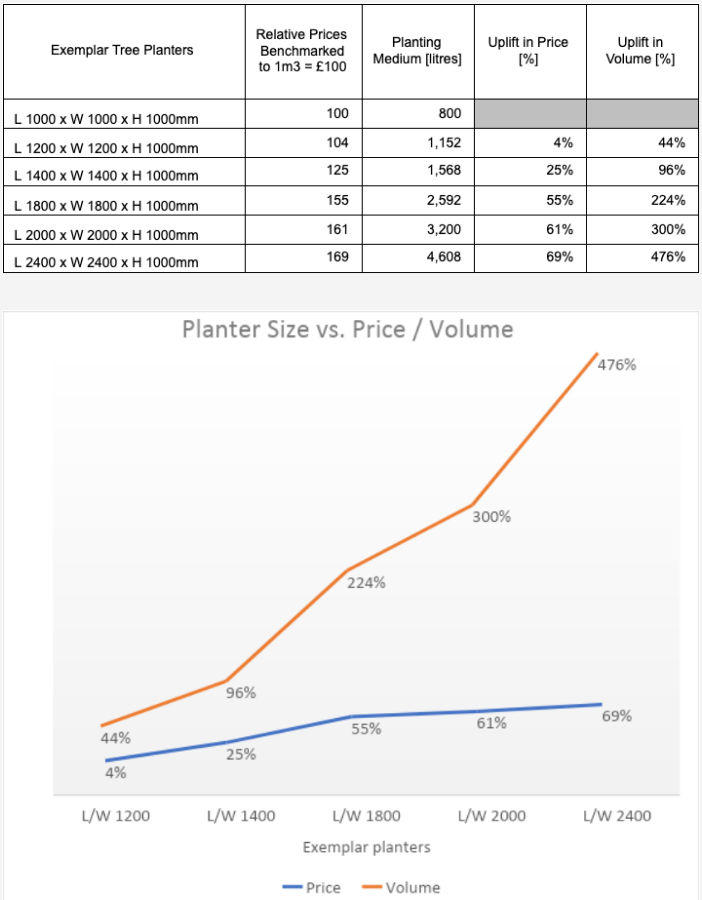
The smallest, 1m3 planter is benchmarked at a notional £100, and other prices are shown as a % uplift from that benchmark.
From this analysis we can see, for example, that:
The 1m3 planter is not only marginal for tree planting, but it is also poor value for money. Unless there is a compelling reason not to, it is better to grade up L 1200 x W 1200 x H 1000mm – which only costs 4% more, but delivers 62% more planting volume.
The scale benefit increases the larger the planter – the benefit is progressive.
In the extreme case, the L 2400 x W 2400 x H 1000mm planter costs only 69% more than the 1m3 planter, but delivers a whopping 476% extra volume.
So bigger is definitely better – in general terms, and all other things being equal.
C. Weights and loadings
This is one of the most common FAQ with tree planters – and the good news is that loadings are almost never an insurmountable problem.
Weights
We are often asked to estimate the weight of the planters, but that information is, in fact, of very limited value. In the vast majority of conventional planting schemes, the planter itself is normally less than 10-20% of the total planted weight; and 80-90% of the weight is down to the planting (drainage materials, soil/compost, water, plants/trees etc). So, if weight is genuinely an issue, then the way to address it is via the design of the planting, not the specification of the planter.
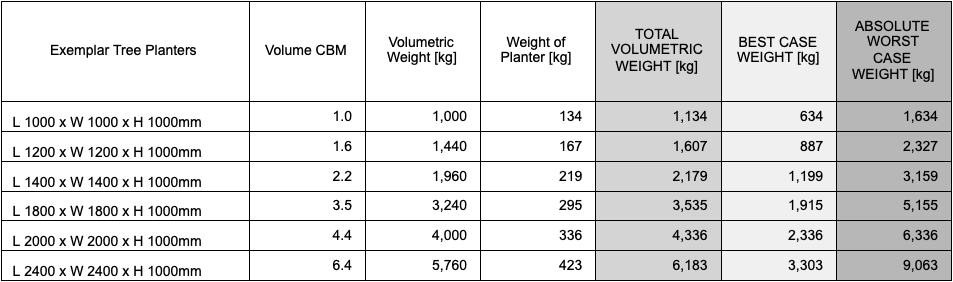
In terms of trying to estimate total planted weights, nothing to do with plants/planting is a perfect science (not least, as assumptions are wholly dependent on conditions - particularly as it relates to water saturation). However, it is generally accepted that a metal planter (unless it has a very big/heavy tree in it) will weigh less than the volumetric weight based on 1 CBM = 1 tonne.
This volumetric weight would be an operational worst case, in most circumstances, and it is more likely that a basic shrub planting scheme would be only 50% of that weight. However large trees can, over time, add quite a lot to the weight, so it is prudent to apply a 50% uplift in those unusual circumstances – as an absolute worst case.
Below are the estimated weights of the exemplar planters:
Planter weight exemplars
Notes
- Volumetric Weight is based on 1 CBM = 1 tonne (1000kg)
- Total Volumetric Weight is based on Volumetric Weight + Weight of Planter
- Best Case Weight is based on 50% of Volumetric Weight + Weight of Planter
- Absolute Worst Case Weight is based on 150% of Volumetric Weight + Weight of Planter
- A lighter-weight, more free-draining planting medium than top soil, which is very dense, must always be used
D. Material specification
Relative to a landscaping scheme based around simple shrub planters, a tree planting scheme tends to be a lot more ambitious and expensive, and thus expectations of return-on-capital and longevity tend to be higher. Also the growth of trees, over the years, can place the planter under much greater strain than with shrubs, so tree planters typically need to be specified at a sufficient level to be ‘future proofed’.
Aluminium has distinct merit in some situations. However, aluminium is a poor choice for tree planters. Aluminium is a lot more expensive than steel; and in sheet form it is a lot less stiff than steel, so typically one has to ‘gauge up’ with aluminium (ie to achieve the same strength and stiffness as 3mm steel, one might need to use 4 or 5mm aluminium). So with the kinds of loadings that can be expected with a tree planter, aluminium works out extremely expensive, and it is almost never specified for this design application.
So it is really down to what choice of steel. Unless at the ‘entry point’ of a 1m3 tree planter (where 2mm thickness might do), any other size of tree planter must be at least 3mm steel. In extreme situations only, 4mm might be cost-justified – but generally 3mm is sufficient up to the largest size discussed here – L 2400 x W 2400 x H 1100mm.
As to what choice of steel, the lowest-cost fit-for-purpose option will always be some form of galvanised mild steel (such as zintec) with a high-quality polyester powder coat (PPC) paint finish. However, as said, expectations of return on capital and longevity tend to be high with tree planters, and they are often to be located in high-traffic public places – so there is a strong argument to consider 1.4003 stainless steel for tree planters.
E. Internal strengthening and bracing
Relative to simple shrub planters, tree planters will need to be robustly strengthened. For simple, geometric, square tree planters, as discussed here, the simplest solution is to have internal cross braces, in a diamond configuration to allow space for the tree root ball. Larger tree planters might also need to have bracing across the corners; and further strengthening will be required if the planter is to be moved – as below.
F. Moving tree planters
In public realm, it is common for tree planters to be placed over underground utilities, in which case the spec might call for them to be movable – even if only in an emergency.
However, each of the above options introduce a void space under the planters; and, on larger schemes, with large tree planters, Environmental Health may object, on the basis that these voids could create rubbish traps and/or vermin habitats. In such cases, the only option is to make the planters liftable from above, via sturdy eye bolts welded inside the rims. The rims, and the entire planter bodies also have to be strengthened against crushing loadings ttypically by creating a complete internal box section frame within the planter); and often a lifting rig must be designed, fabricated and certified, specific to the planter and tree. All of this makes lifting from above a lot more expensive than lifting from below via forklift or pallet truck.
The only silver lining is that, where lifting from above is mandated, it is often in situations where the tree planters are particularly massive, and the trees will likely be massive too, and in need of aerial guying. So the eye bolts welded inside the rims can serve a dual function – as further described below.
G. Tree anchors and aerial guys
Any tree above a 10/12cm girth will need to be ‘staked’; and conventional tree stakes used in open ground really don’t work in planters. The alternative solution is to fasten the root ball with a tree anchoring system. Many of these systems are available on the market, and they all work in essentially the same way – by cradling the root ball, and anchoring it down to 3 or 4 secure points underneath. With sheet metal tree planters, it is a very cheap and effective solution simply to bolt steel eye bolts through the base, to form these secure anchor points.
Large, mature trees will also need to be secured via aerial guys – typically these are galvanised wire cables looped around the tree trunks at elevation, and then led back to sturdy eye bolts welded inside the rims.
The tree anchor eye bolts in the base of the planter (and/or the aerial guy eye bolts welded inside the rim) can also be use to assist with putting the empty planters in place, with either a forklift or telehandler.
H. Reservoirs
Trees can be expensive, and they need a lot of water, particularly in the first one or two seasons. And water must be provided throughout their life in the planter – as, unlike when planted in open ground, a tree in a planter cannot grow tap roots to access underground water.
Therefore, a tree planter specification will always need to include some kind of water supply – either an external supply fed into the planter, or a water reservoir internal to the planter.
I. Thermal insulation
Thermal insulation is not strictly mandatory, but the trees will thank you for it. And big trees can cost big bucks, so keeping them happy and healthy can often be cost-justified.
We use 25mm Celotex (or equivalent) insulation board, which is effective, inexpensive and lasts forever; and it also has the added benefit that it adds extra stiffness to the sides of the planter. Including labour to install, thermal insulation to all inside faces of the planter (four sides, plus the base) will cost:
L 1000 x W 1000 x H 1000mm £95
L 1400 x W 1400 x H 1100mm £130
L 1400 x W 1400 x H 1100mm £160
L 1800 x W 1800 x H 1100mm £225
L 2000 x W 2000 x H 1100mm £260
L 2400 x W 2400 x H 1100mm £325
Note: IOTA prices as at February 2021