Corten Steel – The facts and the unique benefits
Corten Steel is a ‘Marmite’ material, and it is also widely misunderstood. In this article, we seek to separate the fact from the fiction; and to explain exactly why Corten Steel is a material to embrace when designing and specifying landscape projects.
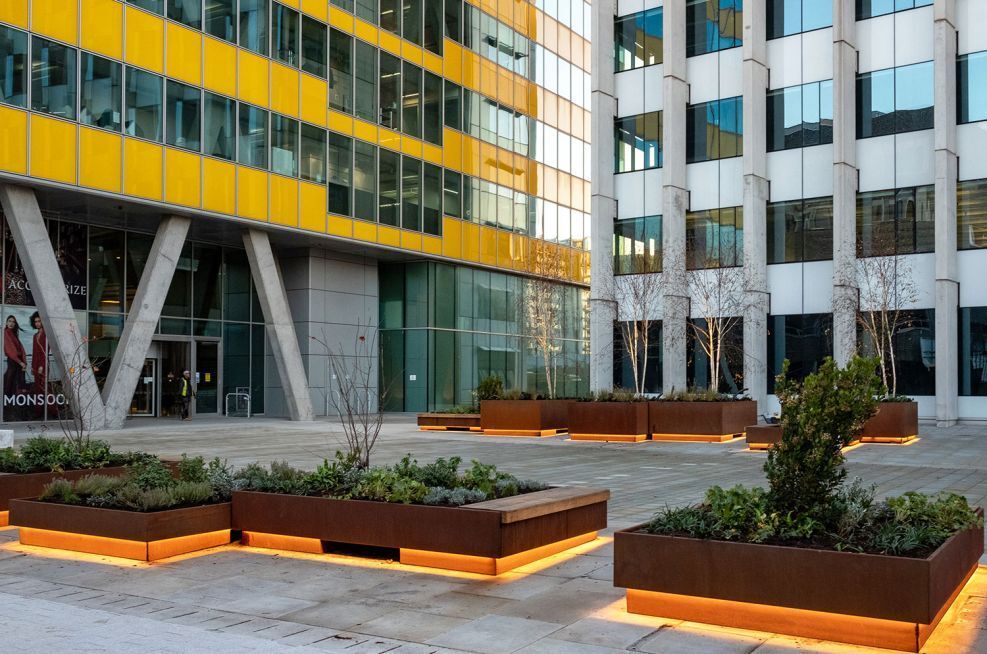
The Key Benefits of Corten Steel are:
- A characteristic aesthetic. Corten develops a variable patina of bronze, rust and copper hues – colours which act as the perfect foil for all manner of plantings schemes, both naturalistic and architectural.
- Extreme longevity. Material loss from unprotected Corten Steel takes place with glacial slowness [in Central London, 0.8mm over 40 years and 2.0 mm over 120 years].
- Low cost. For anything over a 10-year lifespan expectation, Corten Steel offers by far the best value-for-money return of all sheet metals, largely because it never needs to be painted / repainted.
- Essentially zero maintenance. Any maintenance that is deemed necessary would be for purely aesthetic – rather than functional and/or structural – considerations.
Specification Considerations include:
Suitability. At the margin, the longevity of Corten Steel will be affected by the environment, and the aesthetic may vary slightly over time. However, for all practical landscape product purposes, Corten Steel is suitable for ALL environments, including industrial / coastal.
Thickness:
- Corten Steel thicknesses of modest specification [2.0mm or 3.0mm] are perfectly fit-for-purpose for + 25 years longevity, in most environments / applications.
- For + 40 years longevity, an additional 1.0mm thickness should be added, to mitigate the forecast material loss.
- Corten Steel thicknesses =/> 6.0mm work out extremely expensive, and can only be commercially justified if the brief genuinely mandates + 120-year longevity.
- Run-off. Concerns about run-off from Corten Steel are often greatly over-stated. In the vast majority of cases, run-off does not create an issue, so long as the metal has been professionally pre-weathered before supply [as is a standard service from IOTA].
Finishing
- Corten Steel should be left unfinished – not painted, not waxed, not lacquered. Any such surface finish is [i] not needed, [ii] will not be permanent, and [iii] negates the distinct USP of Corten Steel [its extraordinary corrosion resistance in its natural, exposed state].
- In applications where the Corten Steel cannot maintain ideal wet / dry cycles to establish its protective surface oxide [such as the inside of planters], there is an argument to seal inside / unseen Corten Steel with a bitumen damp proof membrane. However, this is ONLY cost-justifiable where longevity expectations are genuinely + 40 years.
Cost
There is a very simple message on the issue of cost:
“For anything over a 10-year lifespan expectation, Corten Steel offers by far the best value-for-money of all metals”.
The reason for this is because:
- Corten Steel is the cheapest of those sheet metals which do not need to be painted [which includes 304 / 316-grade Stainless Steels with a brushed / grained finish – which are a lot more expensive].
- Corten Steel is only around 15-20% more expensive than those sheet metals that do need to be painted [Galvanised Mild Steels, such as Zintec Steel, 1.4003-grade Stainless Steel, or Aluminium].
- For those painted metals, the protective paint layer must be completely refurbished, typically every 10-12 years, with an on-site wet spray application – and those costs will progressively negate, over time, the initial price discount vs. Corten Steel.
In simple terms: after the first repaint, the Galvanised Mild Steels etc. will have cost, in total, about the same as the original cost of Corten Steel; and after their second or third repaint, the Galvanised Mild Steels etc. will have ended up costing a lot more.
Maintenance
For all practical landscaping purposes, in most environments, the maintenance requirements for Corten Steel are either ‘nothing’ or ‘vanishingly little’. And any maintenance that is deemed necessary would be for purely aesthetic – rather than functional and/or structural – considerations.
Specification Considerations
Run-Off
Concerns about run-off from Corten Steel are often wildly over-stated; and it is one of the myths about Corten Steel that this article will hopefully de-bunk. It exists – as a matter of fact, and of science. But it simply is not an issue, in practical terms, if a few sensible steps are taken – both at the point of specification and commissioning, and as it relates to maintenance.
At IOTA, ALL Corten Steel products [such as planters, benches, pergolas, tree guards and grilles etc.] are always supplied by us pre-weathered. This means that they are stored outside at our manufacturing facility for a few weeks, whilst we apply weathering treatments to the Corten Steel, to accelerate its natural curing and patination. This means that the products arrive on site already looking pretty [uncured Corten is a rather dull silver-grey]; and, as importantly, pre-weathering also means that 90% of the run-off has already occurred, within a matter of weeks.
And, if the project programme allows, then we are happy to hold and pre-weather the Corten for longer – and, after 2-3 months, the steel is stable and run-off is essentially non-existent. In fact, after 2-3 months, and even when soaking wet, you have to rub really pretty hard to get anything at all to come off the Corten.
The only caveat to the above is that we would NOT recommend that Corten Steel be placed onto a porous FFL substrate. So, for example, if the FFL is Travertine, Sandstone / Limestone or Marble, or expensive Hardwood Decking, then it would NOT be wise to put [say] Corten Steel planters on top. In those situations, it would be better to place the planters onto the insulation layer underneath [either on Wallbarn mini-pedestals or a drainage mat, to spread loadings], and then to pave / deck up to the sides of the planters, ideally leaving a 5-10mm gap. However, if the FFL is non-porous [such as Granite, or Millboard], then it is no problem to put Corten Steel on top – so long as it has been professionally pre-weathered, as supplied by IOTA.
Graffiti
Graffiti is unwelcome wherever it occurs, and no less so on Corten Steel.
Corten Steel will weather under the graffiti at a different rate to the surrounding metal; so, even if the graffiti is carefully removed through solvent dissolution, there will typically be the ‘ghost’ of the graffiti still visible – at least for some time. So if the graffiti is old [and thus the ‘ghosts’ of the graffiti are highly visible after removal], then it is often better to sand the entire piece back to a uniform pattern, and then let the Corten ‘self-heal’ in the normal way.
Finally, a footnote on the subject of maintenance:
We are often asked why the Corten Steel cannot be ‘sealed’ in some fashion. And some landscape product suppliers do indeed offer that option, so it is ultimately a matter of professional opinion.
In IOTA’s opinion, Corten Steel should be left unfinished – not painted, not waxed, not lacquered – as any such surface finish: [i] is not needed, [ii] will not be permanent, and [iii] negates the distinct USP of Corten Steel [its extraordinary corrosion resistance, and extreme longevity, in its natural, exposed state]. Also, as we have already discussed, any such surface finish will have to be periodically renewed in future, at an ongoing cost – whereas raw Corten, left to its own devices, is an exceptionally low-cost material, for lifespan expectations in excess of 10 years.