Security fencing is designed to deter and deny unauthorised access to a site. Protecting valuable assets and premises from intruders. There are several third-party accreditations associated with tested fencing systems, as they are in place to ensure products are performing to the standards expected.
In recent years, LPS 1175 from the LPCB has become widely recognised in the UK for intruder resistant building components which include fencing, gates, turnstiles, covers and cages. The LPS in the LPS 1175 certification stands for ‘Loss prevention standard’.
It has become popular because it’s easy to interpret and use. The latest issue, Issue 8 made the standard even more universal.
So you might be thinking, how does the classification work and what makes a metal security fence LPS1175 certified? Read on to find out more…
How Does The LPS 1175 Certification Work?
The LPS 1175 has been designed to be universal and to be used for a range of applications. The classifications range from an opportunist attacker with bodily force and basic tools to multiple experienced attackers using chainsaws and petrol grinders.
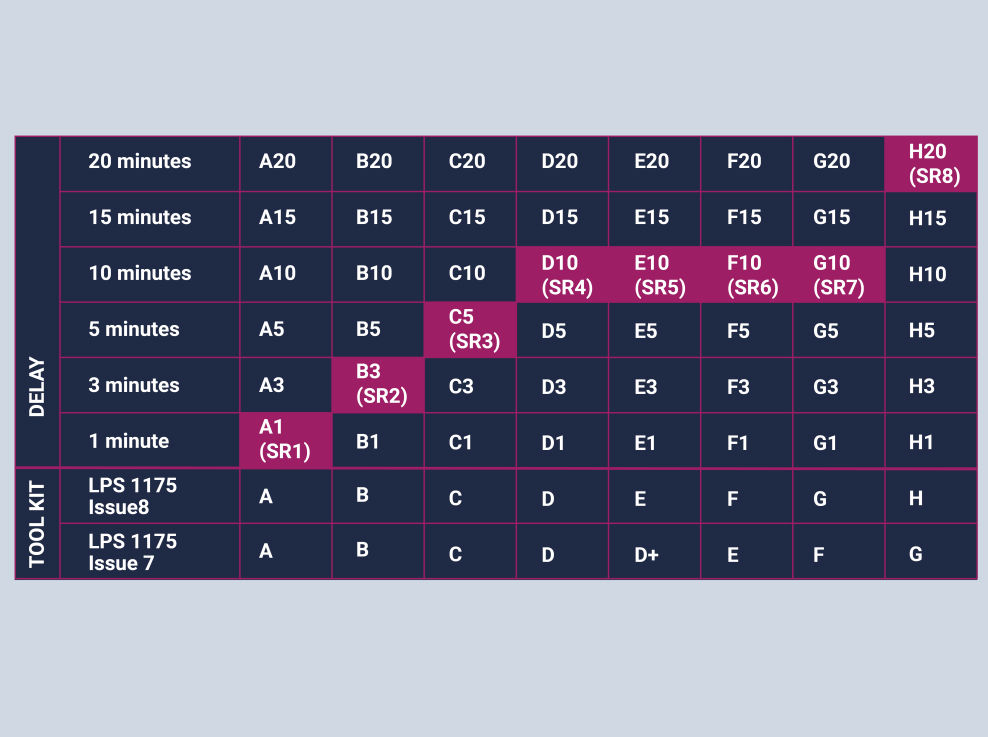
The table shows a matrix of how products are classified. This is done by tool kit and time delay. In Jan 2019, LPCB released their latest issue of the standard, Issue 8 where some of the tools set changed in line with greater access to tools.
Issue 8 completely widened the net and has lead to a flexible classification which is far more realistic.
The new classification represents the toolset used and the time delay achieved (A1. A being the tool kit used, and the number being the resistance time). You may still see A1 being referred to as SR1 as the industry transitions.
Another handy feature of the new issue 8 classification is that products can have multiple ratings. For example, SecureGuard SL2 is certified to prevent an attacker using tool kit B for the 3 minutes and tool kit C for 1 minute.
How Are LPS 1175 Products Tested?
The tests to get LPS 1175 certified are rigid. Meaning all tests are done by the small team of highly experienced, independent testers with the tools set the product is hoping to achieve.
All of the physical security products tested must pass to the same standards, to ensure a consistent level of security across the board. This makes LPS 1175 the preferred certification for security products in the UK.
During testing, each assault continues until either:
- The objective is achieved
- The maximum working time has passed
- The maximum test duration has ended
- The testing team decides the attack is ineffective
Additional tests are then conducted to demonstrate all areas of the fencing can resist the damage inflicted from the intruder’s side.
However, if the tester notes a small weakness once the time has been exceeded, the product will not pass. If they spot a weakness, these highly trained professional will try again and again to see if they can gain access within the timeframe. It’s safe to say it’s a rigorous regime they run!
Layering Security Fencing
To help build up delay time, we often see a layered approach to high-security fencing, especially in high-security areas, such as data and research centres.
Issue 8 also incorporated how a layered approach can be effective. If the threat is perceived to be tool kit C and you need a delay of 4 minutes for security to act to stop the person getting to high-value assets in a certain room of a building you can use a layered approach.
For example, the perimeter could provide B1 protection and a cage could provide a B3 layer of defence.
This is where multiple industrial security fences, of different strengths, are put in place to help increase the delay time.
Conclusion
When it comes to testing products, there are many options available, however the most recognised in the UK is LPCB tested products.
At Barkers, the company offers a wide range of fencing and gates which have been tested and certified by the LPCB, ensuring the highest level of protection for your site.
Barkers has over 12 years of experience designing and manufacturing perimeter security and access, you can be sure to receive expert advice for your specific site.
Get in touch with Barkers today to get free expert advice.