

- Sector
- Culture and heritage
- Project type
- Refurbishment
- Services provided
- Product / system manufacture
- Product / system supply
- Project location
- London
- Client
- Natural History Museum
- Consultant
- Wilder Associates / Niall McLaughlin Architects
- Contractor
- Blakedown Landscapes
- Products used
- Bespoke Yorkstone paving
- Greenschist paving
- Porphyry setts
- Swedish granite setts
- Reclaimed kerbs
Challenge
The aims of this project were to make the main entrance to the Natural History Museum in London wheelchair-accessible, and to upgrade the aesthetics of the outdoor area.
Products used
- Bespoke Yorkstone ramps
- Greenschist edging
- Porphyry setts
- Granite flags
- Reclaimed flat kerbs
Project details
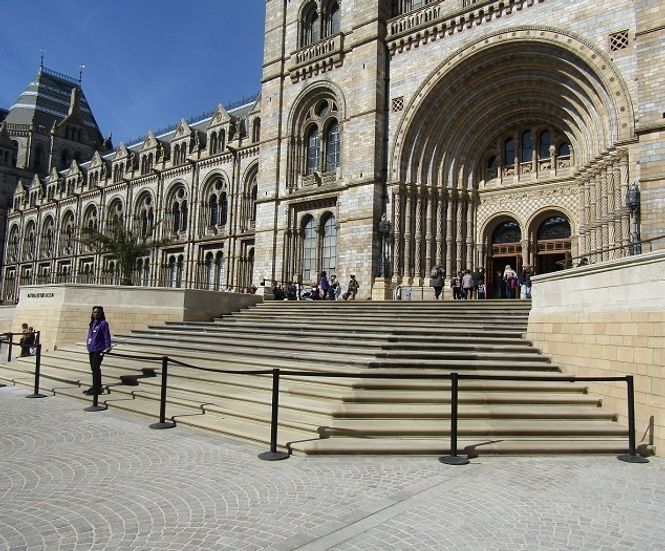
Two bespoke Yorkstone ramps were added on either side of the entrance stairway. Greenschist from Scotland was used as an edging for the Yorkstone, complementing the blue-green porcelain banding in the Museum’s walls.
The lower vehicular frontage was completely transformed. Tarmac was replaced with porphyry setts laid in an arc pattern, with the arcs pointing towards the building. The setts had a special grey palette with a little brown tint, rather than the usual burgundy-violet and orange mix. The original cubes were modified to 60-60mm x 80mm thick because of limited build-up height and smaller setts were used where the arcs met, making the pattern fit better.
A line of setts laid in rows with granite ‘wheeler’ flags set at the width of a cart’s wheels ran all the way up two ramps on either side of the building, set into more tarmac. The tarmac was replaced with the same porphyry setts used on the lower vehicular frontage. The line of setts was extended using a Swedish granite produced in Portugal. Larger setts were used along the outer radius to allow for the curve of the ramp, and the new areas also had to include the same mix of sizes. Reclaimed flat kerbs were identfied as a colour match for the wheelers, however some were too wide so the final pieces had to be carefully selected, avoiding sawn edges which would have ruined the worn, reclaimed aesthetic.