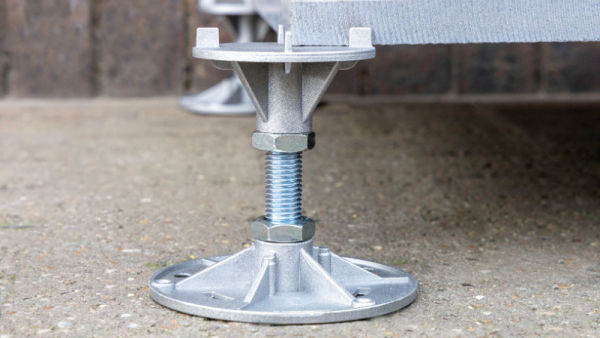
Fire-rated pedestals are a key component in the delivery of safe external flooring applications above 18 metres in height.
Since the 2018 change in Building Regulations – which were brought about by the Grenfell Tower tragedy – more and more building product manufacturers are delivering solutions that help you to achieve compliance.
With so many options out there, this article seeks to explore key elements to look out for when specifying fire-rated pedestals
 .
.
Certification
Unless a pedestal is Euroclass A1 rated, you will need to ensure certification to show that the product produces little contribution to fire.
Products such as the A-PED® are naturally non-combustible due to their aluminium and steel composition. This means that it does not need additional certification in order to be specified on a high-rise attachment.
Products that are Class A2 rated will need certification as they may produce smoke or flaming droplets when exposed to fire. It is important to note, however, that both Class A1 and A2 can be specified on a high-rise attachment above 18 metres.
It is also crucial that pedestal accessories should also be made of appropriate A-rated materials. You do not want to compromise fire-safety with plastic or rubber shims or spacers, for example. This is a really important consideration that should not be overlooked.
Characteristics
When researching fire-rated pedestals, you should seek a solution that encompasses a wide range of characteristics to ensure you get the most out of your spend.
Look out for:
Quick installation capabilities
Lightweight construction
Ability to accommodate heavy loads
Self-draining
UV Resistant
Chemical Resistant
Maintenance-free
Suitable for use in a variety of temperatures
Other components
Of course, the flooring application as a whole needs to be considered when considering design ideas for your next project. As important as they are, pedestals are only one component of a much bigger solution.
In this instance, you need a flooring application that, too, delivers Class A-rated compliance. Thankfully, there are a variety of options to choose from such as porcelain, concrete, natural stone and aluminium all boast non-combustible properties and can create a stunning end-result for the project you’re working on.
Depending on what your aims are – and the purpose of application – each surface material listed above has its own unique properties, allowing you to produce eye-catching (yet safe) flooring, whether it’s a balcony, walkway, terrace or roof/winter garden.