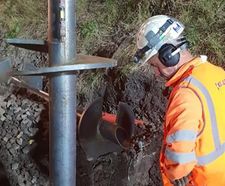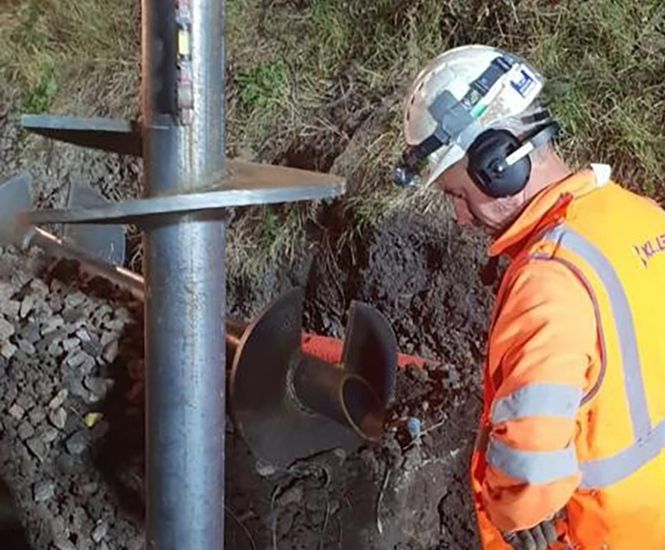


Helical piles, also known as screw piles, are constructed using steel shafts with helical flights of various sizes to suit the site specific ground conditions.
Typical applications
- Structural support (compression or tension) for both permanent and temporary structures
- Underpin existing foundations
- Walkways
- Telecommunication masts/platforms
- Electrical equipment, pylons and poles
- Buildings/modular buildings
- Rail structures (signalling, platforms, overhead line equipment)
- Highways structures (signage)
- Temporary/permanent seating (stands)
- Anchors (back stays/tension guys)
- Retaining walls, flood defences
- Wind turbines
- Solar farms
- Fencing
Installation process
Helical piles are generally installed using standard tracked or wheeled excavators with a torque motor attachment which monitors the torque achieved during installation to verify the design.
The piles are advanced to the predetermined (design) bearing strata by rotating the steel shafts with the torque motor attached to the excavator plant/rig. Multiple steel sections are connected via a bolted connection and sections are added to complete the total pile depth.
Helical flights strategically designed along the shaft penetrate the soil without augering, displacing the soil, whilst the torque is carefully monitored as the pile advances. The final torque reading is taken over the last 1m of advancement to ensure the pile is achieving the required design before terminating at the correct datum level.
Helical piles are able to restrain a range of different axial, uplift and shear forces, although these are solely dependent on the soil conditions present at site. Larger loads can be restrained by simply increasing the pile diameter and wall thickness, size of helix plates and helix quantity on each pile. Each project is individually analysed to ensure the local conditions are adequate for the project specifics. Keller will assist the client to propose the most economical solution for their project in line with the client's requirements for programme and budget.
A detailed understanding of the subsurface conditions (especially soil strata type, strata levels and strength (SPT ‘N’ Values) to depth is necessary to properly interpret the required design and torque capacities.
On completion, the top of the pile can be connected in various ways to the structure by a direct steel flange plate connection or plate/rebar connection to concrete.
Key benefits
- Permanent or temporary applications
- Removable using the same equipment and method reducing environmental impact
- Reusable so a sustainable product
- Can be loaded instantly, reducing programme time and cost
- Can be installed in all weather conditions
- No spoil
- Can be installed in contaminated soils
- Can be installed in most soil conditions
- No noise or vibration during installation