Driven cast in-situ (DCIS) piles are constructed by driving a closed-ended thick-walled steel casing into the ground and then filling it with concrete. They can be used as foundations for new buildings (residential and commercial), and are ideal for large distribution warehouses, bridge abutments and piers, and floor slabs and load transfer platforms
Click for full image
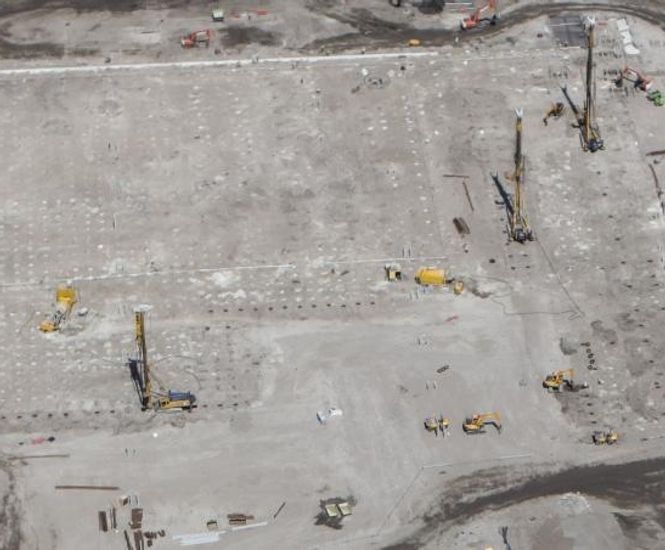
Driven cast in-situ piles for high-bay storage facility
Driven cast in-situ (DCIS) piles are constructed by driving a closed-ended thick-walled steel casing into the ground and then filling it with concrete.
Typical applications
Foundations for new buildings (residential and commercial)
Ideal for large distribution warehouses
Floor slabs and load transfer platforms
Bridge abutments and piers
Where ground conditions are highly variable as they are driven to a set or pre-determined resistance
Regeneration sites where a legacy of obstructions would otherwise damage pre-formed piles
Installation process
The 25mm thick heavy steel tube is driven with the end closed by a steel shoe. On reaching the required driving resistance, a full length cage is lowered in to the tube and filled with high slump concrete. The tube is then vibrated out leaving a shaft of concrete. When supporting industrial or warehouse floor slabs, a monolithic 900mm diameter pile head can be cast to a precise level at the top of the pile, avoiding breaking piles down.
Key benefits
Quick to install and can be installed with an integral pile cap to reduce the thickness of any floor slab supported by them
Significant load capacities
No need to dispose of the spoil associated with displacement piling
Extensive range of pile sizes, typically from 340 to 630mm diameter
Potential to overcome hard bands or minor obstructions
Provides a self-sealing displacement pile which limits contamination pathways to the surface which can occur with other piling techniques