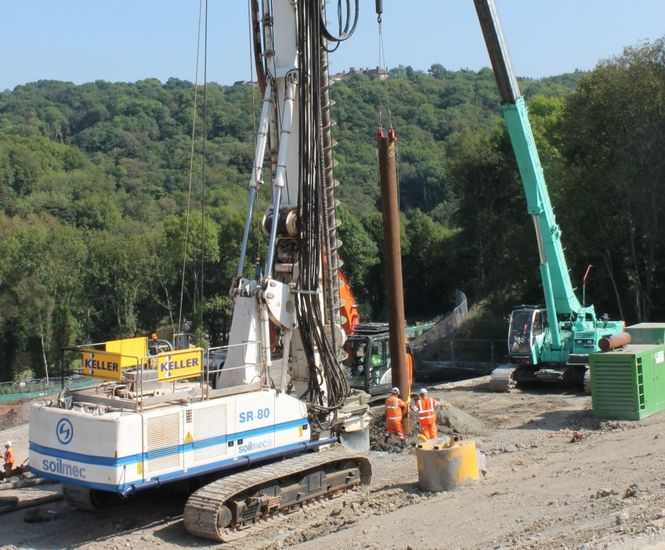


Continuous flight auger (CFA) piles are drilled and concreted in one continuous operation enabling much faster installation time than for bored piles. Reinforcement is placed into the wet concrete after casting, enabling the pile to resist the full range of structural loading.
Typical applications
- Structural support
- Earth retention, especially on site boundaries or close to adjacent buildings
- Prevention of landslides or protection of existing buildings (often combined with other techniques such as ground anchoring or soil nailing)
- Infrastructure projects such as tunnelling, road or bridge construction as well as flood protection
Installation process
CFA piles are constructed by rotating a hollow stem continuous flight auger into the soil to a designed depth. Concrete or grout is pumped through the hollow stem, maintaining static head pressure, to fill the cylindrical cavity created as the auger is slowly removed. The reinforcement cage is placed through the freshly placed concrete. Typically, Keller CFA piles are reinforced with a rigid six metre-long cage as a minimum, but it’s possible to install much longer cages as and when required by the design or specification. If required, a specially developed vibrator unit can help accurately locate the reinforcement cages.
Key benefits
- Resists compressive, uplift, and lateral loads
- A cost-efficient foundation solution
- Can be installed in most soil conditions such as sands, clays, silts, gravels and soft rock
- Can achieve pile depths up to 32m and with various diameters from 300 to 1000mm or more
- Low noise level and no vibration and low noise level so ideal in built-up areas with weak soil conditions and high levels of ground water
- Compared to bored piles, construction is very quick as temporary casings or support systems are not required