
- Sector
- Transport infrastructure
- Project type
- Refurbishment
- Year completed
- 2018
- Project location
- North West England
- Client
- Balfour Beatty Mott MacDonald (BBMM) Joint Venture
- Contractor
- BDB Special Projects
- Products used
- SDS Aqua-Xchange™ granular treatment media
Overview
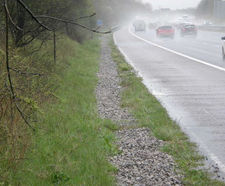
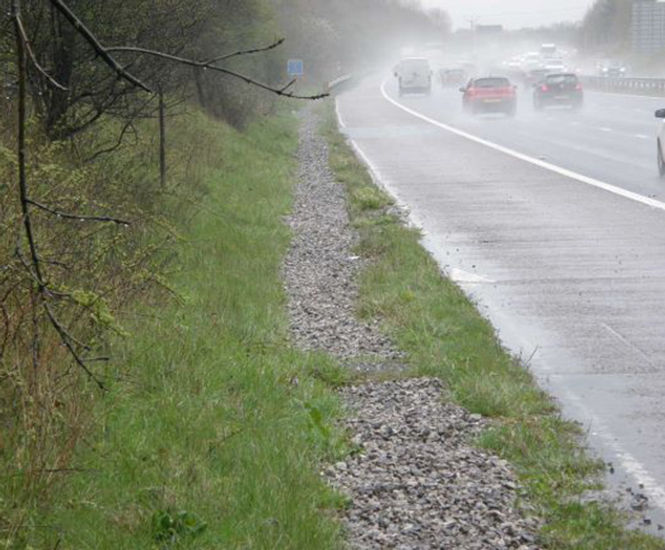
BDB Special Projects installed SDS Aqua-Xchange™ granular treatment media into an existing filter drain along the M56 to prevent pollution of a vulnerable stream, which receives run-off from a 1km stretch of the motorway via a single outfall. Aqua-Xchange™ is designed to capture and retain copper and zinc, poisonous metals released through the abrasion of tyres and brake pads, which dissolve in surface water during heavy rain.
As part of their Highways England Area 10 maintenance contract, designers from the Balfour Beatty Mott MacDonald (BBMM) Joint Venture first investigated the potential of Aqua-Xchange™ to deal with pollution entering Mag Brook, a small stream that runs through farmland near Lymm in Cheshire. Their risk assessment revealed the need to reduce the soluble zinc content in the run-off by a minimum of 7% and the soluble copper by 52%. Water from Mag Brook flows via another stream, Bradley Brook, into a small lake known as Lymm Dam, a local nature reserve; Mag Brook is a small tributary with limited water flow to dilute the run-off from the motorway.
The filter drains that line the sides of the carriageways are stone-filled trenches that provide a highly-effective and sustainable way of capturing the suspended solids in the run-off; they are, however, not capable of capturing soluble pollutants.
About Aqua-Xchange™
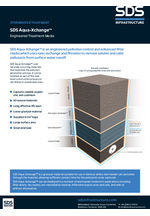
When added to the filter drain, a layer of Aqua-Xchange™ uses the processes of adsorption and ionic exchange to capture the metals dissolved in the run-off as they filter through the material. The chemical process forms unbreakable bonds, so pollutants are retained even during heavy storms and winter road-salt applications.
BDB Special Projects completed the installation in Nov 2018. A total of 184 x1m3 bags of Aqua-Xchange™ were delivered to site, which BDB set out at 7m intervals along each side of the carriageway so that the correct volume of material could be applied evenly.
As there were cabled services in the existing filter drain, a vacuum excavator was used to remove the existing stone to the desired 400mm depth. A team followed directly behind to line the trench with a geotextile membrane, then a grab wagon was used to lift and discharge each cubic metre bag of Aqua-Xchange™ material into the trench and it was raked level. Old stone was removed for cleaning and re-use.
The 250mm layer of Aqua-Xchange™ was covered with a geosynthentic grid for surface stabilisation, then with a final layer of clean stone, designed to capture initial suspended solids and gross pollutants before the water is treated by the Aqua-Xchange™ beneath. The water then continues to percolate through the non-woven geotextile wrap and filters through a further layer of stone before entering the perforated pipe at the bottom of the trench. The cleaned water is discharged into Mag Brook.
Result
BBMM’s risk assessment showed that Mag Brook was vulnerable to pollution because of the high traffic volumes travelling to and from Manchester and the airport. With no space to build SuDS ponds or other vegetative features behind the carriageway to treat the metals, or to install a manufactured stormwater filter to capture the pollutants, it would have been extremely problematic to mitigate the pollution risk otherwise.
Using SDS Aqua-Xchange™ has also meant less excavation and less disruption, and there will be no need for maintenance during the 15-year design life.