

- Sector
- Housing, private
- Project type
- New build
- Year completed
- 2019
- Products used
- Jakcoustic® Reflective acoustic fencing
Context
Three villages and 2,450 new homes have been built 2.5km east of Aylesbury in a scheme described as Britain’s most wildlife-friendly housing development.
Barratt Developments, David Wilson Homes and Aylesbury Vale District Council worked in partnership with the RSPB to "show that new homes need not be at the expense of the natural world". The new villages include: bat and swift boxes, hedgehog highways, wildlife corridors, planting for wildlife, and sustainable urban drainage. The site is made up of 50% wildlife-friendly green space, with ponds, parks, meadows, orchards and a nature reserve aimed at retaining as much green space as possible.
Requirement
During phase 1, noise mitigation was required to satisfy planning permission, to protect residents from noise from link roads and a large electrical substation. Following noise assessment, it recommended “the installation of acoustically sound fencing at certain locations”. The noise assessment determined that day- and night-time noise levels exceeded the levels outlined in WHO guidelines and BS 8233:2014.
For amenity spaces such as gardens, WHO guidance advise that external noise levels should not exceed 50dB. Also, the National Planning Policy Framework (2012) advises that planning policies with respect to noise emissions should aim to: avoid, or mitigate and reduce to a minimum, noise and other significant adverse impacts on health and quality of life as results of new development.
To provide a quieter environment for the residents and wildlife, and to protect them from noise disruption, the noise assessment recommended that fencing should meet this minimum spec:
- made from good-quality timber with minimal knots
- at least 2.5m high
- at least 25mm thick
- closeboarded to minimise gaps
- no gaps between gravel board and ground
- minimum mass of 10-15km/m3
Jacksons' acoustic fencing systems exceed the minimum requirements for fencing around the development, with a thickness of 34mm, and mass of 25km/m3.
Solution
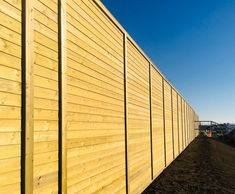
As part of a £20m contract, MV Kelly was employed to complete infrastructure works and groundworks, including the construction of a 7m-high, 450m-long acoustic barrier around the electrical substation. The acoustic barrier consisted of a gabion wall with an acoustic fence on the top. Jacksons provided 335m of 4m-high Jakoustic® Commercial and Highway acoustic fencing which was installed on top of the earth bund. The fencing is installed on galvanised steel I-beams providing strength and durability. It is also the only complete timber acoustic barrier system to hold a CE mark. Reflective acoustic fencing works by reflecting noise away from its flat profile, which is very effective in large open spaces.
The timber facade of the acoustic barrier can reduce noise by up to 28dB*, and fits well with the development's ‘natural’ theme. The fence disguises the substation, providing residents with a more aesthetically-pleasing view.
Jacksons' acoustic barriers are designed to be anti-climb, so security around the development is also increased, and intruders are deterred from accessing the electrical substation surrounding the barrier. With a 25-year guarantee, the acoustic fence will provide noise reduction and protection for the residents and wildlife for many years.
*Jakoustic® barrier certified laboratory results: rating according to BS EN 1793-2:1998 Category = B3 Laboratory sound reduction 28 dB Superficial mass 25kg/m².