

- Sector
- Culture and heritage
- Project type
- New build
- Services provided
- Installation
- Year completed
- 2017
- Project location
- London
- Client
- Serpentine Gallery
- Contractor
- AECOM
- Products used
- GEOlight® geocellular storage
Context
Visitors to the 2017 Serpentine Pavilion in London’s Kensington Gardens will enjoy its spectacular effects unaware of the below ground water management solution provided by sustainable drainage company SDS.
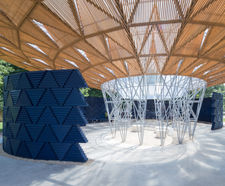
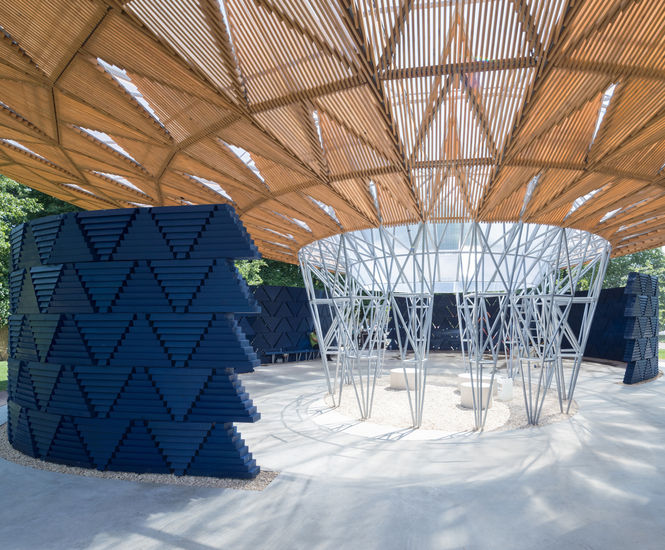
A dramatic rainwater cascade from the Pavilion’s arching tree-like roof canopy is a central feature of this year’s design by the award-winning Burkina Faso architect Diébédo Francis Kéré.
Kéré’s creative interpretation of the Serpentine Galleries’ annual commission for a temporary exhibition pavilion was influenced by the British climate.
Rain collection
“At the centre of the Pavilion is a large opening in the canopy, creating an immediate connection with nature. In times of rain, the roof becomes a funnel channelling water into the heart of the structure. This rain collection acts symbolically, highlighting water as a fundamental resource for human survival,” explains Kéré.
During peak summer storms, rainwater is designed to run off the Pavilion’s expansive roof into an open central courtyard, so an underground attenuation solution using GEOlight® geocellular storage from SDS was designed by the engineering project team from AECOM.
The roof canopy is supported by a central steel framework and covered with a transparent twin-wall polycarbonate skin. With the roof pitch varying between 5° and 9°, the rainwater is conveyed quickly through a funnel before dropping into the centre of the courtyard.
Underground storage
The water flows down from the roof onto a publicly-accessible, elliptical-shaped 21m2 area of 130mm-deep cream-coloured granular stone, before being conveyed to the GEOlight® storage tank beneath. The underground storage is designed to hold back up to 6,000 litres of water, sufficient to protect against a 1 in 100 year rainfall event. Water is then gravity-fed slowly away via two surface water pipes to an existing soakaway.
AECOM has provided technical advisory services for the Serpentine Pavilion project for the past five years. Principal Engineer, Michael Orr explains: “This is the first time in recent years that a positive drainage design has been required for the Pavilion, as this time rainwater is part of the architectural concept and is featured by being directed into the centre of the structure.
“The architect’s tree-like construction required a strong reinforced concrete raft foundation. Also considering the clay ground conditions, it was necessary to design a central attenuation tank using GEOlight® geocellular storage to capture rainwater and take it away from the foundations, allowing it to infiltrate slowly into the park’s existing soakaway system.
Outcome
SDS Limited was delighted to provide 6m3 of GEOlight® geocellular storage for this prestigious project, says Sales and Marketing Director Richard Averley:
“The relationship between nature, architecture and public space is central to Francis Kéré’s design. As is so often the case, it’s the engineering behind the scenes which has enabled a sustainable drainage concept to be realised.”
The Serpentine Pavilion is open to the public between 23 June and 8 October 2017.