

- Sector
- Housing, private
- Project type
- New build
- Services provided
- Design
- Project location
- Wales
- Client
- Taylor Wimpey
- Consultant
- QuadConsult Ltd
- Products used
- Hydro-Brake® flow controls
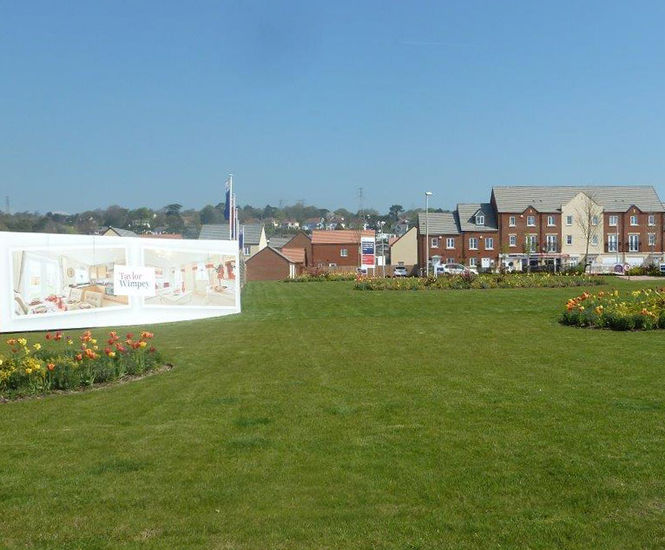
Engineers took a pragmatic approach to designing surface water drainage at Taylor Wimpey’s new Parc-y-Strade housing development in Llanelli. Using Hydro-Brake® vortex flow control technology to engineer distributed surface water storage and attenuation across the low-lying, flat site, the development infrastructure satisfies Sustainable Drainage Systems (SuDS) principles.
The high-density development of 355 homes situated in a coastal plain could be prone to flooding. Consulting engineers QuadConsult Ltd specified 29 Hydro-Brake® Flow Controls to control surface water and manage underground storage.
The area is located near the River Loughor inlet with extensive coastal wetlands and could be threatened by flooding. Flat topography means drainage flow is a major concern. To help improve this, the site was built up by c900mm. Even so, the invert levels of the discharge points are 3m or more below development levels.
Parc-y-Strade is being built in 3 phases, each one discharging separately to the Cille Stream, which was de-culverted as part of the development to provide an effective flood mitigation measure for the area.
Consulting engineer Richard John of QuadConsult developed the detailed drainage solution for the development site:
“It’s a typical coastal plain location with a high water table due to the tidal range and the estuary. Rainfall is about 1150 mm a year, peaking in winter, so an 8.7 hectare site with numerous access roads and impermeable areas will have a considerable amount of water to deal with,” he explains.
“In such a high-density, flat site, with many hard surfaces, achieving the desired attenuation with a predominantly soft scheme using many ponds would have been difficult and would also have occupied valuable building land.
“In addition, maintenance and adoption of such features can pose a problem to the relevant authorities, who are happier with the known characteristics of engineered drainage.
“We specified the Hydro-Brake® Flow Controls to provide distributed storage and attenuation throughout the site and maintain discharge volume within the planning consent limits. Hydro-Brake® Flow Controls with their low maintenance requirements are accepted for adoption by Welsh Water, so were the obvious choice.
“The final flow control is a Hydro-Brake® Optimum, which offered the best storage volume to discharge ratio with a limited 450 mm sump depth, allowing us to minimise storage requirements while meeting the 100-year storm event planning criteria, even with 30% added in for climate change.”
Stormwater attenuation structures have been installed within the adoptable sewer network to accommodate the 30 year return period storm event.
Modular block storage tanks collect surface water from private roads, roofs and driveways. They are sized to accommodate rainfall events greater than the 30 year return period storm up-to-and-including the 100-year return period event (including an allowance for climate change) and are located under non-adoptable areas.
Storage discharges to the adoptable sewer network via 28 76mm Hydro-Brake® Flow Controls with a maximum design flow of 3 l/s. The sewer network collects the surface water and conveys it to the adoptable attenuation structures for temporary storage where a Hydro-Brake® Optimum attenuates the final discharge to the receiving watercourse at a maximum 13.9 l/s/ha to meet planning requirements.