

- Sector
- Transport infrastructure
- Project type
- Refurbishment
- Services provided
- Planning advice
- Design
- Year completed
- 2016
- Project location
- London
- Client
- London Luton Airport Operations Limited
- Consultant
- Mott MacDonald
- Contractor
- Whitemountain
- Products used
- SDS GEOlight® attenuation tanks, Aqua-Swirl™ separator and flow controls
Challenge
In September 2014, London Luton Airport Operations Limited (LLAOL) commissioned Veolia Water Projects Ltd to develop a surface water management strategy for the airport. The strategy was to address the prerequisites to achieve planning consent for the airport’s further expansion.
Data collected from water quality monitoring conducted between 2005 and 2012 had identified the main pollution risks as oil spills and de-icing chemicals.
Any contaminated surface water would flow to a number of water receptors: the Luton Hoo Lake and the River Lea, to which UK/EU Environmental Quality Standards have been applied, and an underlying Principal Chalk aquifer, which is monitored against UK Drinking Water Standards for Groundwater.
Phase 1 of the new development programme included the resurfacing and expansion of car parking areas, extensions to buildings and the construction of a new dual carriageway.
The main impact of this first phase of development was the increased risk of flooding caused by multiple new impermeable areas. This was in addition to a known flooding problem that already existed on Airport Way, which provides main access to and from the airport.
Therefore, the new drainage scheme was to protect habitat and amenity by improving water quality but also prevent the increased risk of flooding.
Solution
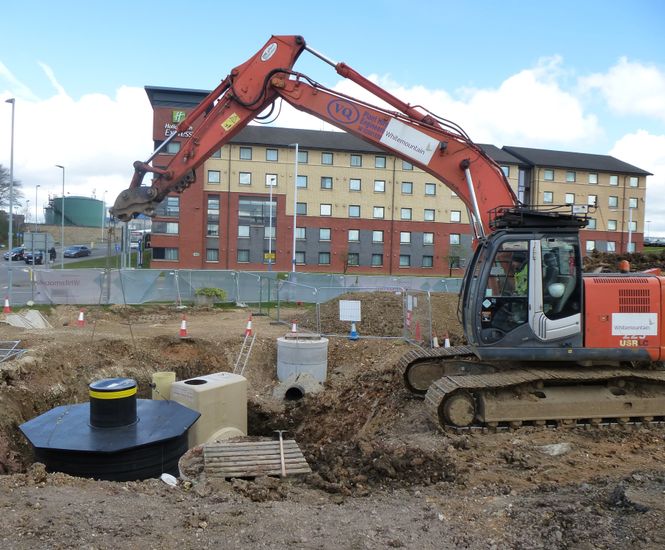
In late April 2016, SDS installed a new SuDS system to handle surface water runoff from Luton Airport’s extended medium-term car park.
The system includes five SDS GEOlight® attenuation tanks that have a combined storage capacity of up to 4,277m3 of water. Upstream, two SDS Aqua-Swirl™ hydrodynamic vortex separators remove approx. 90 to 95% of the total pollutants in the surface water runoff volume.
Sufficient capacity exists within the underground storage facility landside to accommodate excess airside surface water runoff, the first flush of which will be highly contaminated with substances, such as de-icing chemicals and will be diverted to the Thames Water foul system for treatment.
The system has been designed to series 500 of the specification for highways works and sewers for adoption. It follows engineering consultancy Mott MacDonald’s flood risk design for a 1:100 year storm event, including an allowance for an additional 20% due to climate change.
Surface water drainage is managed in accordance with the ‘Design Manual for Roads and Bridges’ (‘DMRB’), the ‘Manual of Contract Documents for Highways Works’ (‘MCHW’) and ‘Sewers for Adoption Seventh Edition’.
Outcome
As well as providing the site with essential control over water quality, the choice of SDS Aqua-Swirl™ was of particular benefit to infrastructure drainage contractor Whitemountain.
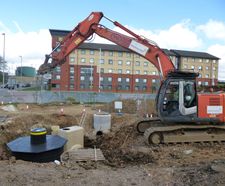
Site Engineer at Whitemountain, Brian Fegan, explains: “The installation of a system comprising a device of concrete construction, until now our only option, would have required the use of a 350 tonne crane and most likely, due to the massive inconvenience not just to us but to the airport and local road network, would not have been feasible at all. The Aqua-SwirlTM’s versatility meant that we could design the devices for the specific requirements of this site, without the need for any bends in piping, whilst their inherent strength allowed us to save on time and cost through not requiring a concrete surround. Their compact size and small footprint, together with the lifting supports and straps provided, meant installation was very quick and simple and final placement could be done manually; we needed only a single day in which to dig, position, connect up and back fill”.
An additional benefit of the SuDS system has been the reduction, to a great extent, in the frequency and volume of the flooding that occurred in the neighbouring Airport Way underpass.
Whilst the flooding hazard for both carriageways continues to remain categorised as ‘significant’ for a 1 in 100 year storm event, the severity of flooding across the access route in a 30 year event has been reduced to the category of ‘moderate’ for one carriageway whilst, for a 1 in 10 year event, the second carriageway is deemed entirely clear.
Furthermore, for all return periods, the hazard remains in place for a maximum of only 2 hours, thereby significantly reducing the duration of restricted access, whilst the installation of a pump, which is able to transfer flows to the SDS GEOlight® tanks, ensures that emergency access can still be gained at all times.